Name:
Emilio Vavarella and Daniel Belquer
Title:
MNEMODRONE
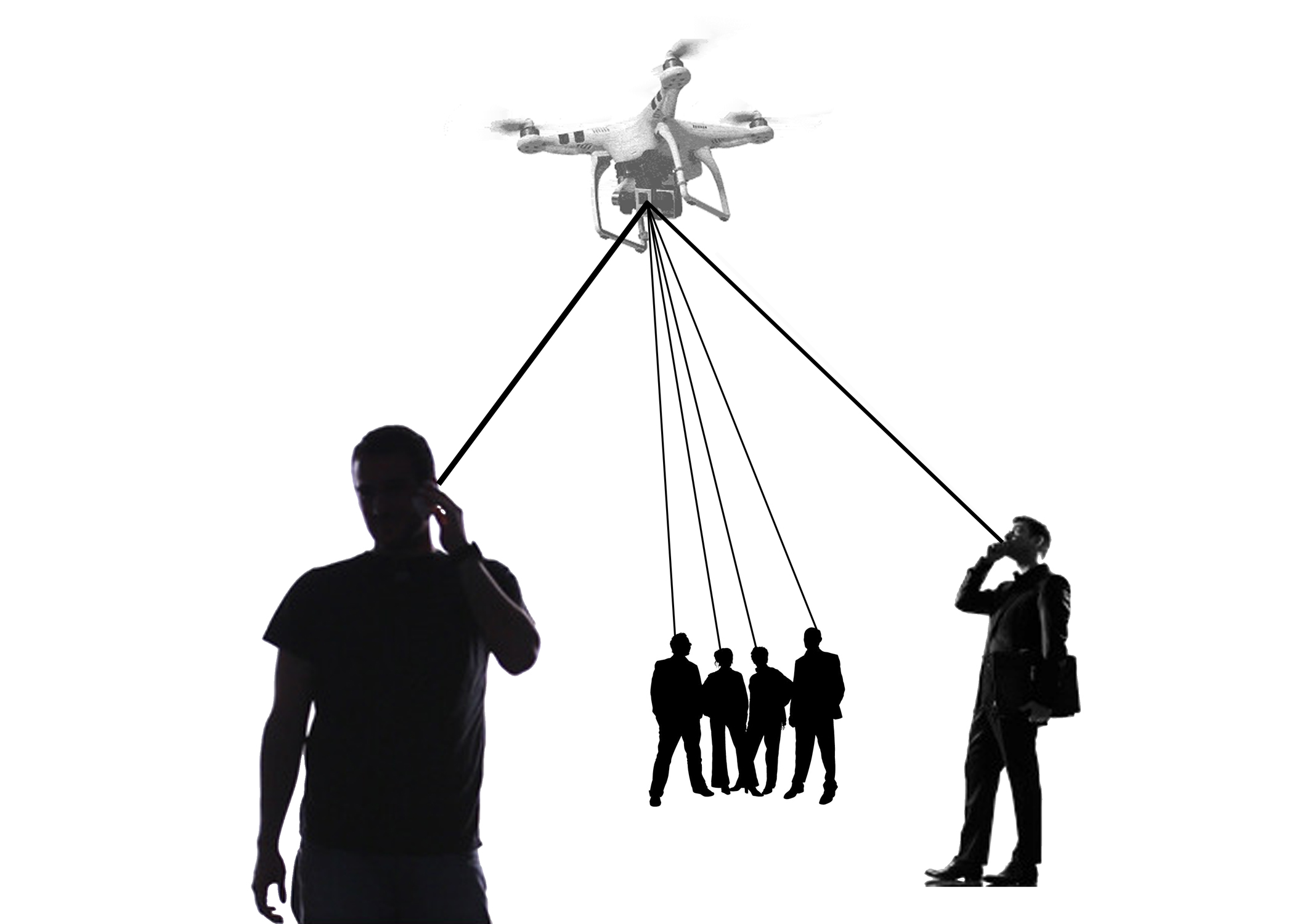 Emilio Vavarella and Daniel Belquer, MNEMODRONE, 2014-in progress. Mixed media, multiple locations.
What does “FREE” mean to you?
EMILIO: It means everything, but it can easily be reduced to an illusion. Sometimes I ask myself if, in fact, people are not terribly afraid of being free. But our project mostly deals with the possibility of freedom and the fear of the unknown. In the case of MNEMODRONE we developed a project that engages these issues from different perspectives. We are offering to the public a particular situation and only a vague guidance, this means that the public will decide freely how and if to interact with MNEMODRONE.
DANIEL: Free is the maximum amount of balance between restraints (social, physical, emotional, chemical, biological, etc.) and the sensation of being able to act.
Why is 14th Street a compelling site for creative response?
EMILIO: Let’s think about New York’s environment, the structure, the architecture, the cars, the trains, and the technology behind it and how that has shaped the humans that inhabit that particular space. The urban environment has been transformed constantly by technological innovations, which always impact the public sphere. The advent of drones will change it again, probably in a drastic way. It makes perfectly sense to work on the interaction between humans and drones in the center of one of the most urbanized places of the Planet. Our project intends to investigate possible future developments in a speculative way, but its approach is deeply rooted in the specific social reality to which it refers.
DANIEL: Because is a perfect portrait of New York’s cosmopolitan character.
What reactions are you hoping to draw from the public?
EMILIO: While awareness is an important aspect, we’re not looking for any specific way to interact or take part in our project. Every kind of interaction, or non interaction, has for us the same importance. We’re more interested in observing and only then draw, if possible, some conclusion, or more probably pose new questions. These are a few questions on which we’re focusing while involved in this project, and that are directly related to how the public will engage with our project:
Is it possible for a machine to act based on collective memories? What kind of memories are people willing to share with a machine? Are we ready to believe that a machine can develop a personality? What’s the difference between memory, personality and consciousness? Is it possible to develop a consciousness based on collective memories? Can consciousness be artificially developed? What’s the relationship between memory and consciousness? What kind of relationship between humans and machines can emerge from the drone-collected data? What makes people start or stop collaborating with machines? Will people experience the project as a new invasion of their precarious privacy? Will people think of it as a scientific experiment, an event, a game or all of these things in various combinations? Will people refuse to take part in it? And what can that tell us about humans? Are we able to share memories with a machine in the same way we share memories with a real person? Is the Bergsonian idea that memory contains a living dynamic automatism applicable to machines?
DANIEL: Awareness.
Please feel free to refer to the page of the project ,where we put together not only a short background on the project, but also our ideas on how to continue developing it after the Festival. The participation in AIOP is the first step of a longer project.