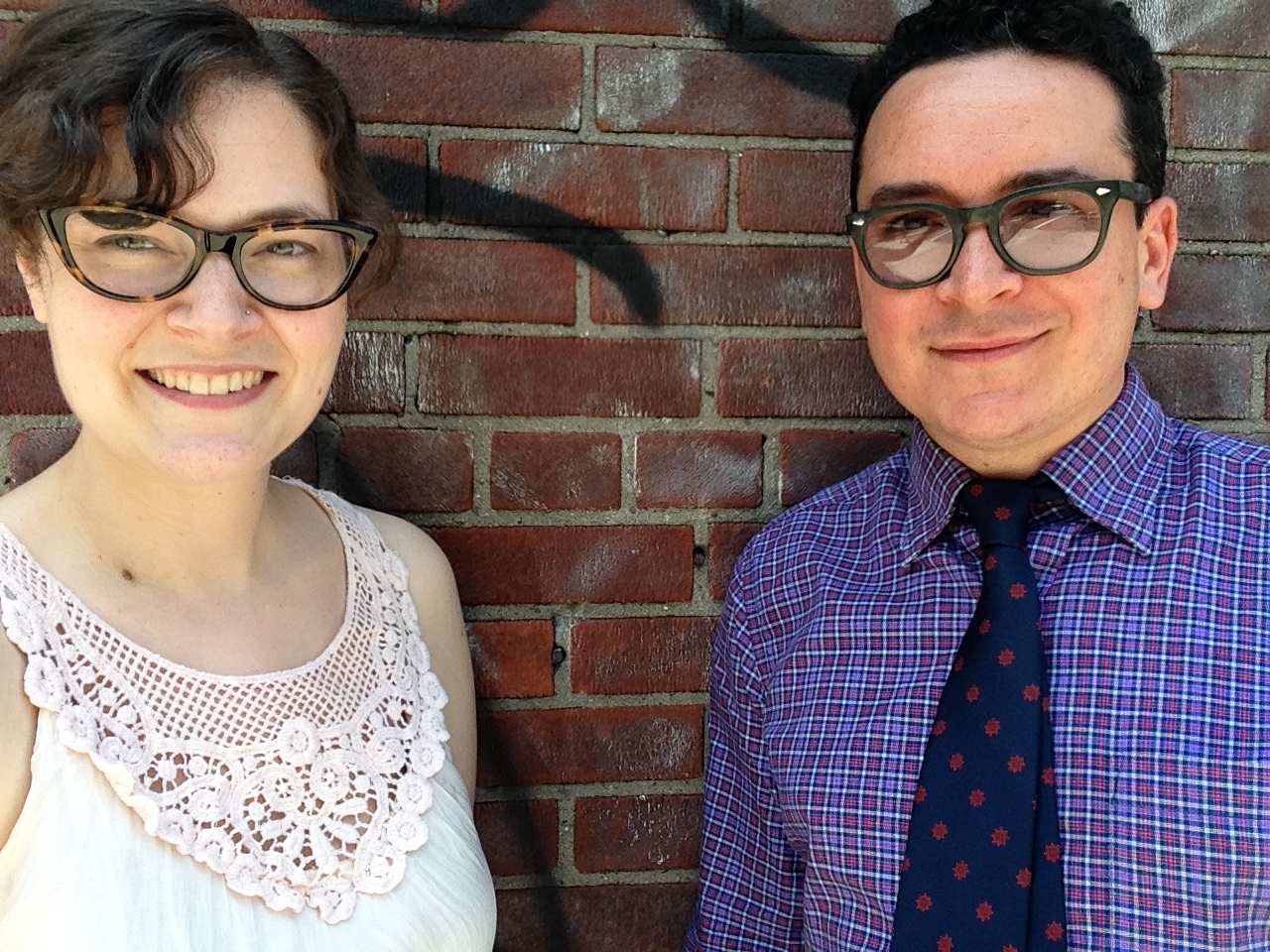
Juliana Driever and Dylan Gauthier, AiOP 2014: FREE co-curators
Tell me about yourselves?
Juliana Driever: Depending on who you ask, I’m: a curator, a writer, a teacher, an administrator, a freelancer, an editor, a mother, a wife, a daughter, a sister, a friend, a vegan, a feminist, a virgo, a facilitator, a misfit, a truth-teller, a participant, a helper, a perfectionist, an opinion-haver, a New Yorker, a rambler. But it’s all the same to me.
Dylan Gauthier:I’m an artist, curator, and educator, working with a particular focus on interactions in common space, digital media, invisible infrastructure, collaboration, and public art. I’m a co-founder of the artist and water activist collective the Free Seas (http://www.thefreeseas.org), and the Sunview Luncheonette (http://www.thesunview.org), and I also collaborate frequently with Sam Gould/Red76 (http://www.red76.org).
JD: Dylan and I have known each other for quite a long time. We worked together at Gigantic ArtSpace [GAS] in the early aughts, with founder/director Lea Rekow. Since then we’ve worked on a few other projects together, including an exhibition at the Boston Center for the Arts last fall. Doing production and exhibitions work can get really intense, but being amongst friends has also made it so much fun.
How did you first get involved with AiOP?
JD: Ed and I met in 2011, and I was immediately drawn to the spirit of the festival. I had done quite a bit of work with site-specific and public art, but had been feeling frustrated with the myopia the art world — and with the culture of permissions that stymies so many of us working to create professional opportunities. He asked me to organize a public program for AiOP 2011: RITUAL in conjunction with the Institute for Urban Design, as a part of the inaugural Urban Design Week festival. That was my first contribution to the AiOP community. The panel that I put together – Rise and Fall: Contemporary Nautical Practice on the Gowanus Canal – included Dylan as a panelist, and Jeff Stark (who is a participating artist in 2014) as moderator. Since then, I’ve involved myself each year in various ways. Last fall, we launched the catalog for AiOP 2011: RITUAL (which I edited) at Residency Unlimited. That night, Ed asked me if I wanted to curate this year’s festival. It was a really nice way to come full circle with AiOP.
DG: I was invited by Juliana to be on a panel a few years back as part of AiOP and Urban Design Week about artists who to reclaim the water as viable public space. That was my first personal involvement with the festival, though I had encountered it once when I lived on 14th Street in the 2000s, but only put it together when I started reviewing the work from past festivals. Over the years I’ve seen a ton of documentation of work that was originally produced for AiOP – it crops up during curatorial reviews and in a public art context – though likewise I don’t think I had consciously made the connection that all these great and very memorable projects were being created for this singular festival, which is, in reality, also an artist project by Ed Woodham. When I put all these threads together, I knew I wanted to be involved, and I was thrilled when Juliana invited me to work with her on putting together this year’s show.
How did you decide on the theme for this year’s festival?
JD: When we began talking about possible directions for this year’ theme, FREE was a concept that had already been at the front of my mind for some time. Ostensibly, getting something for free is great, right? But it didn’t take long for us to see that the idea is also fraught with contradictions, and can be really quite polarizing. Understanding what it means to be free, or to get something for free, or to give something away for free is open to a whole spectrum of interpretations — from the utopic to the dystopic. We liked that.
DG: Juliana had already selected the theme when she invited me to co-curate with her, but I wasn’t sure exactly what it meant to call a festival “free” or to force art to be “free”, or how to connect it to 14th Street, which is both a very free and a very restrictive place. As a concept, FREE is totally demodé. Once a promise and a marketing pitch, it has now taken on the sense of the unwanted – a commodity too plentiful, perhaps, or just unwanted. (For if someone wanted it, the thinking goes, it wouldn’t be free.) But a different conception took shape through our long conversations and e-mail exchanges about what FREE could actually mean –– the promise the word might still hold in its very freedom, the word free as an empty signifier – at that point it seemed like the best idea for a festival about public art which is no less than three kinds of free: free (no admission), free (organized by an all-volunteer staff), and free (in that it doesn’t seek any permission or permits to do what it does, but tries to get artists to share their work freely with the public).
JD: Also, it seemed an interesting concept in relation to AiOP, which is an event that has always been pulled off with no budget, and without official permissions. I think it’s a common misconception that AiOP is a 501 (c)(3) organization, or that there’s some kind of operating budget, or that there’s an infrastructure for operational support — but in actuality, it’s just a group of extremely dedicated core collaborators who all lend their expertise to pull off something incredible.
Have you done much work with public space before?
JD: Yes, I’ve worked in the public context quite a bit. Beyond my involvement with AiOP since 2011, I’ve been involved in a number of curatorial projects organized in response to particular public spaces. I was also the curator for the Queens Borough Public Library for a number of years, where I ran a contemporary art program within the central and community libraries.
DG: Much of what I do as an artist takes place in public spaces or deals with questions about the public sphere, public engagement, or the construction of publics. As a curator I have thought about art in public and wondered (and written about) what the dividing line is between a public work and a private one. So it is what I think about and work with all the time.
JD: I love museums and galleries, too. They’re really important parts of the cultural ecosystem. But working in public space — and continually evolving an idea of what, exactly, that constitutes — is in my view the most direct and accessible way to create cultural experiences.
14th St. is AiOP’s biggest collaborator, what about the space have you been keeping in mind as you are preparing for the festival?
JD: That the festival isn’t just for an artworld audience. 14th Street is so diverse. It’s such a challenging space to program and organize.
DG: Mainly, that there are many 14th Streets: it is a finite place constantly opening up onto a multiverse. Like a fractal, when you look closely enough at it, the widest street in Manhattan contains all of the possible patterns of the larger city.
JD: How do you get the Union Square shoppers to break stride? How do you figure into the cultural tourism and high-end retail experiences along the west side of 14th Street? How do you excite the interest of local residents on the comparatively quiet eastern end of 14th Street? And, how do you provide a well-rounded visitor experience for the art cognoscenti who come out for the festival? It’s a chaotic set of questions to grapple with.
What kind of dialogues to you hope to see created through this year’s festival?
DG: I’m excited to think that each of the artists making work for the festival will be in dialogue with the site, with the theme, with their medium, and with each other.
JD: There is going to be a lot to respond to, and so many audiences to appeal to for engagement. An issue that I foresee a lot of potential discussion around is: digital space as public space. We’re working to realize multiple opportunities for public programming, and will announce our full schedule of events in September.
DG: Juliana and I, along with Meredith Degyansky, are really pushing the public programming component of the festival this year to be something more multidimensional than a panel discussion – more anarchic, more free. We’re hoping to engage diverse actors from the local communities (both in, around, and beyond 14th Street) on a wide array of topics: from architecture and sculpture, urban planning or unplanning, big data and digital interfaces, gentrification and development, and the changing shape of 14th Street itself. In doing so we hope to create a dialogue around the respective ways that public art and public space are conceived of, instrumentalized, and employed to reinforce a specific form of urbanism. To this end we’ve invited a collaboration with the Free University, which is putting out a separate open call for talks and classes.
How has preparing for the AiOP festival impacted your own artistic practices and professional development?
JD: For me, there is no “practice” to speak of. In terms of professional development, I think it’s really tested my desire to control everything all the time. You can’t control the street.
DG: Right now it’s working with the 73 amazing artists involved in this year’s festival, along with all of the AiOP team – Juliana, Ed, the Claires, Sandra, Meredith, Matt, Carey, Jorge –– that is keeping me challenged and inspired, and I’m super excited to see everything come together this October.