Presenting visual and performance art in unexpected public spaces.

AiOP 2013: NUMBER lookback: Speaking of this year’s theme FREE, last year’s Dreams for Free artist, Jody Servon, who was just on TedX Greenville, recalls her time in NYC with curator Radhika Subramaniam.

By Radhika Subramaniam

As artists are gearing up for the AiOP 2014: FREE festival, here are a few insights from last year’s festival…


Had you worked in public space before?  How was this experience similar or different?

I have been working in public spaces for years. Rather than working by myself in a studio, I involve the public as participators in my projects. My aim is to provide platforms for people from all backgrounds to share their stories.
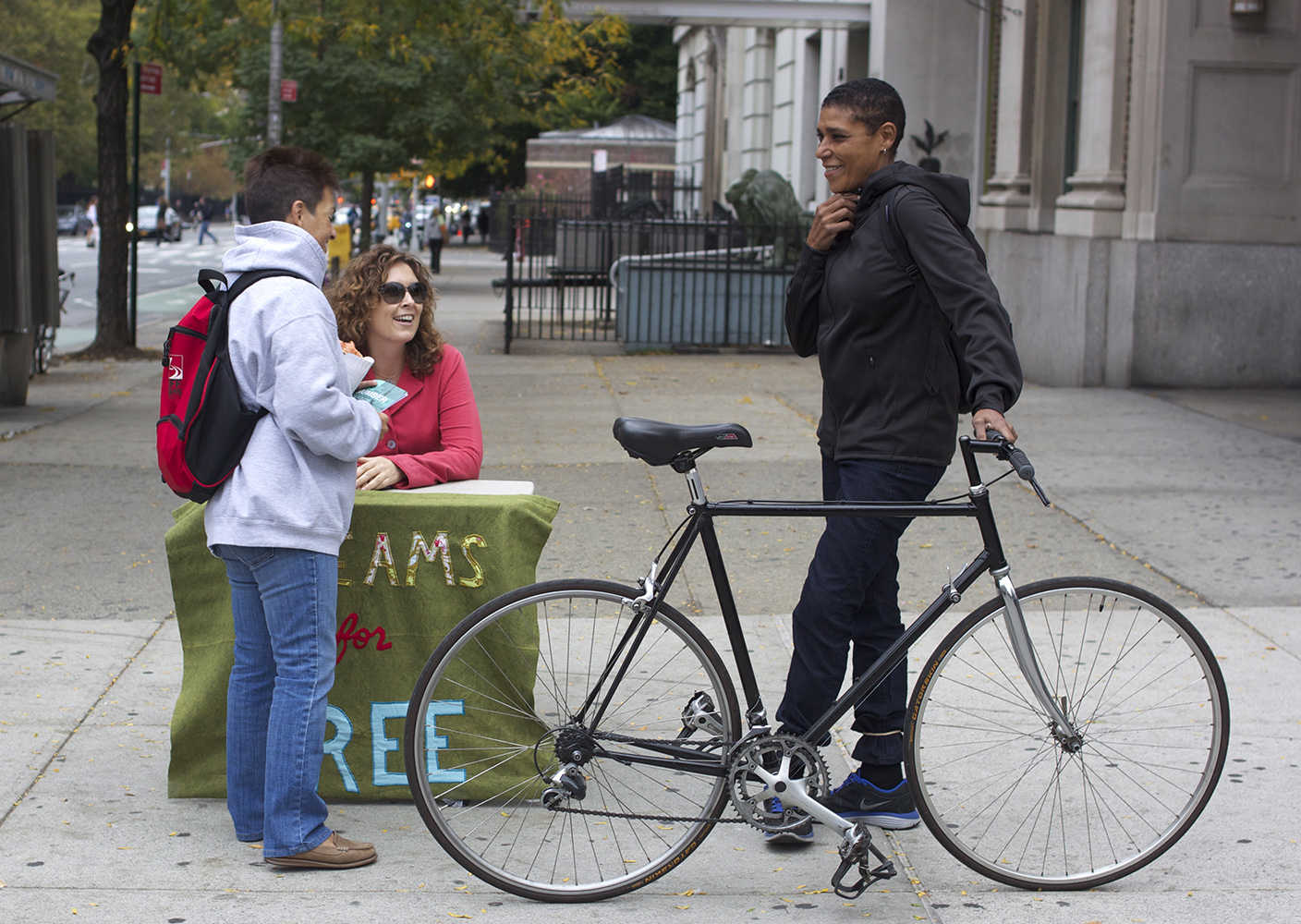
Servon2 Photo credit Janie Ledford

Photo courtesy of Janie Ledford.

14th Street is AiOP’s biggest collaborator – both as an ally and as a competitor.  How did you adapt your work to the location? 

Initially I planned to walk along 14th Street and interact with people I encountered along the journey. I picked a time when I thought people might be agreeable to interacting with a stranger—Friday afternoon. I was anxious about the reception I would get on the 14th Street. I wasn’t sure if people would want to share their dreams with me. The first few people I approached that afternoon confirmed my fear. They weren’t into sharing anything with me—much less what they would do with millions.

Then, I spent a little time observing people and realized that people taking breaks or waiting for transportation might be more open to engaging with me. People standing on the sidewalks smoking were the first dreamers of the day. I especially loved watching the woman with a plastic cape, a hair full of dye, and a cigarette dangling from her lips as she scribbled her hopes for 37 million dollars. I also encountered a cluster of MTA workers who had just finished their shifts—these cheerful men and women enjoyed telling each other what they would do with the winning. I wondered how many of them kept dreaming on their commutes home that afternoon.
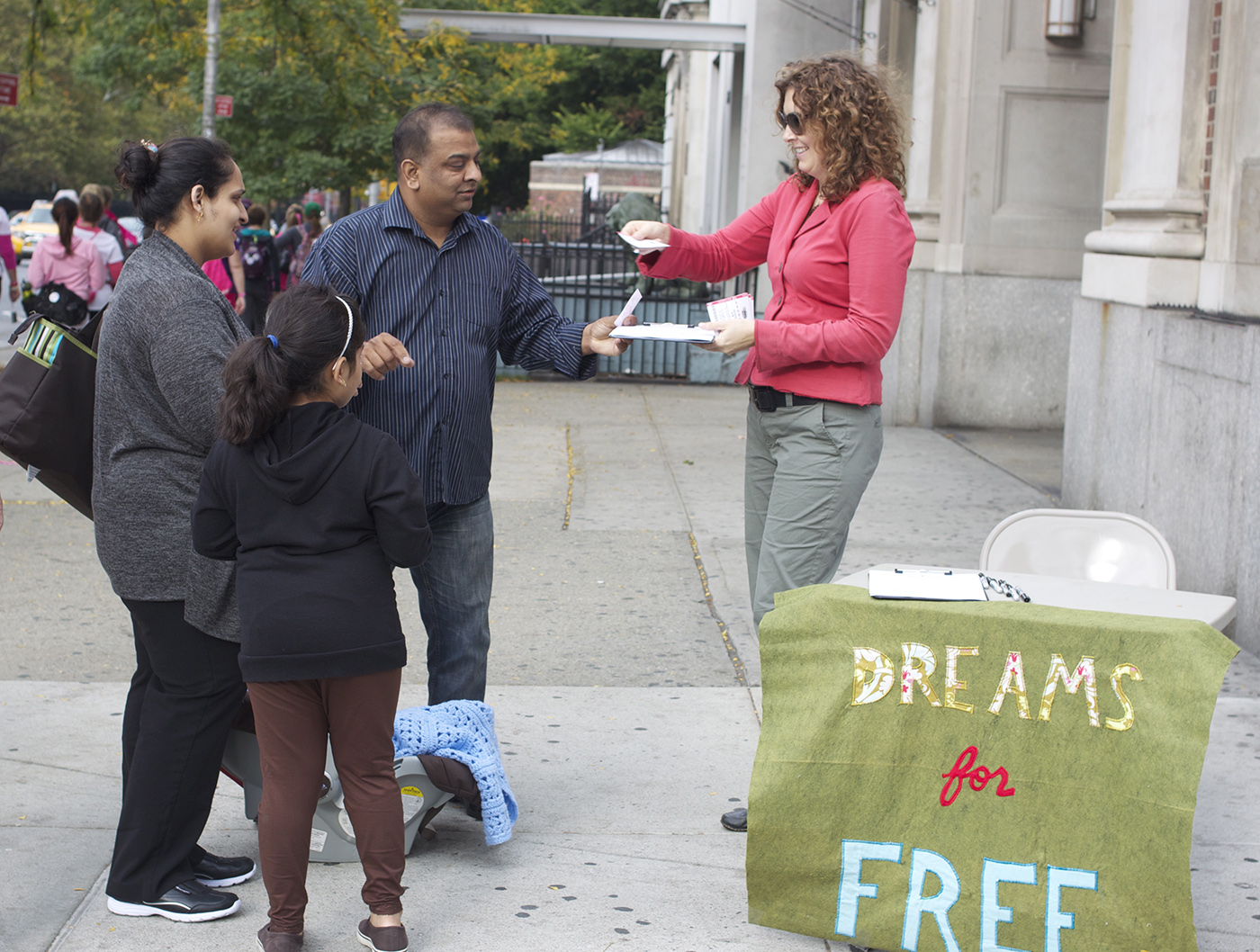
Servon 1 Photo credit Janie Ledford

Photo courtesy of Janie Ledford.

The following afternoon I spent more time interacting with strangers on 14th Street. Instead of approaching people on foot like I had done the previous afternoon, my assistant, Janie and I set up a table with my Dreams for Free banner. We chose a location where there was good sunlight and lots of pedestrian traffic—the northwest corner of 2nd Ave and 14th Street. Shortly after settling into our location, we realized that we had camped out along the route of a Susan G. Komen Breast Cancer walk/run. Throughout the afternoon we were engulfed in sporadic pink swarms. These walkers were focused on their task and were not interested in dreaming. I pondered how many would give the money to cancer research if they enabled themselves to pause and take a chance on winning millions.

Was there one memorable moment?  

One hundred people wrote down their hopes and dreams for me while on 14th Street so it is difficult for me to highlight one memorable moment. I appreciated people’s willingness to stop whatever they were doing and dream. I loved the woman who was scheming with her young son all that they would do with their windfall—their enthusiasm was infectious.

Do you have an association between number and place to add to our numerologies? 

I have given away lottery ticket in amounts ranging from $12,000,000 to $363,000,000 and I thought that as the amount increased the dreams would become more involved and maybe even outlandish. But the amounts didn’t seem to matter much when people’s most common dreams were to pay debts, buy a home and give to charities.
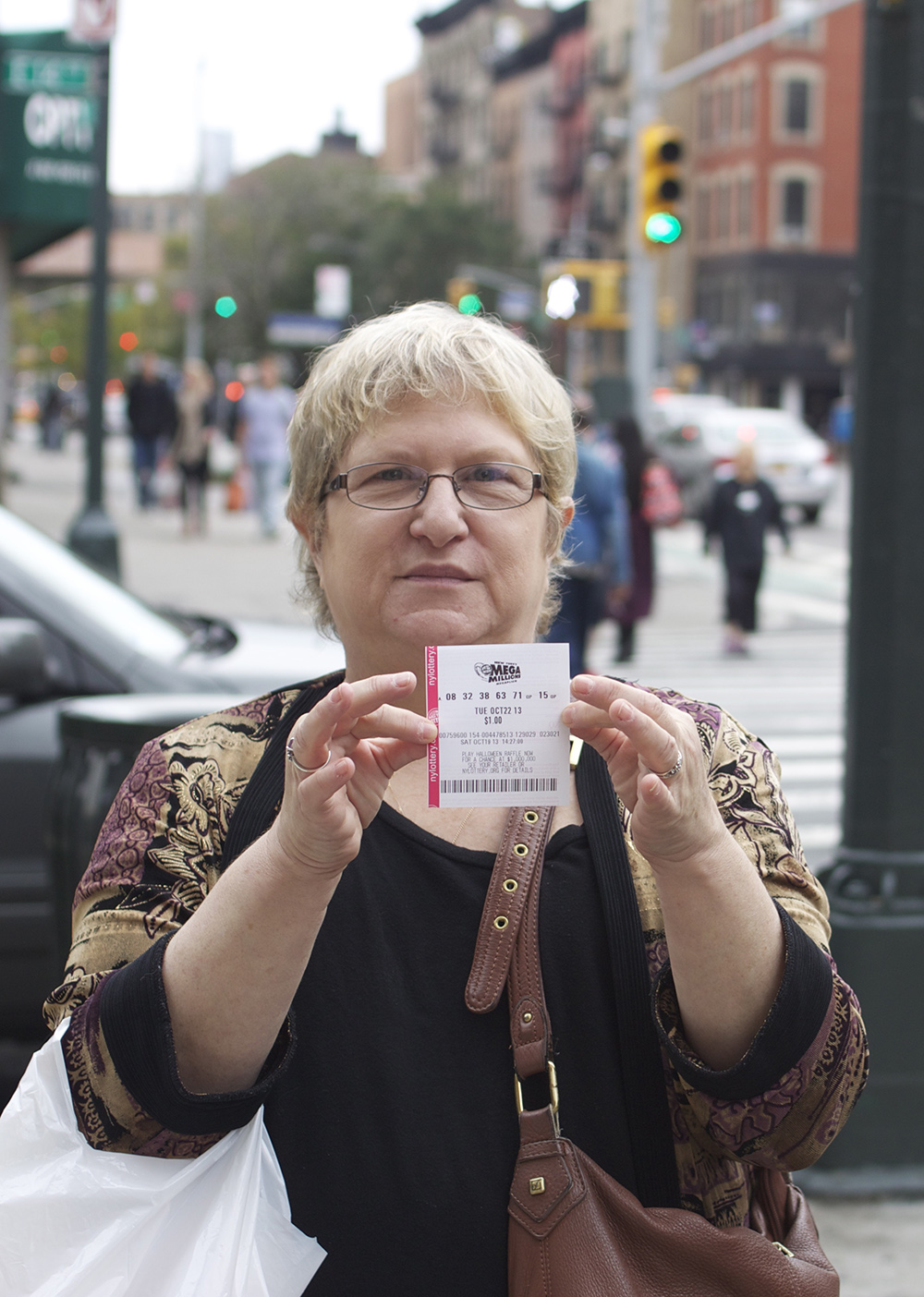
Servon3 Photo credit Janie Ledford

Photo courtesy of Janie Ledford.

What was the oddest experience or the greatest surprise?

The amount of people who, when contemplating what they would do with millions of dollars, wanted to pay off debts, have a home, a working car, and an education was truly surprising. After meeting over 600 people throughout the course of this project and learning their dreams, I am in awe of how many people are dreaming of survival and not having to worry about meeting their basic needs. I am an artist and an educator with two small children. I struggle to make ends meet. I thought I was aware of others’ challenges. This project taught me that I am just one person with my view of the world, and how important it is to get to know more about the people who surround us.

Anything else you’d like to add?

Thank you so much for including my project in AiOP Number. I have a project website that includes dreams from people I met through AiOP. http://www.dreamsforfree.org/37.html

http://www.dreamsforfree.org/55.html

Also, be sure to check out her talk from TedX Greenville.
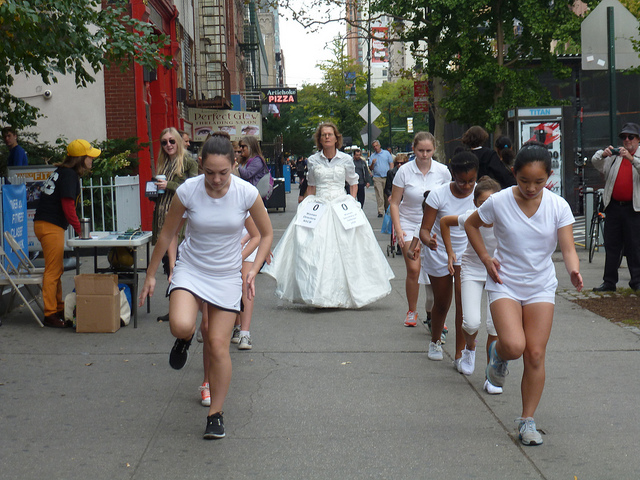
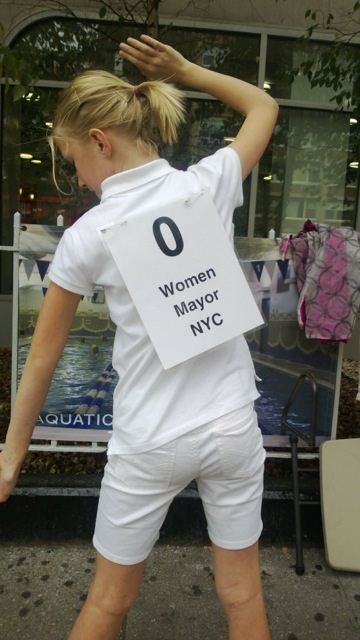
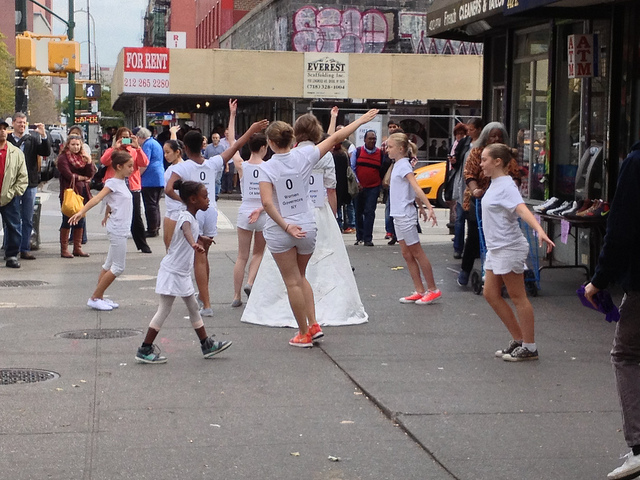
AiOP 2013: NUMBER lookback: Paula Hunter and the young dancers of JUMP! (the youngest being 8 years old), who came down from Rhode Island to perform 0 (Women), talk to curator Radhika Subramaniam about their time in NYC as part of AiOP 2013: NUMBER.

By Radhika Subramaniam

As artists are gearing up for the AiOP 2014: FREE festival, here are a few insights from last year’s festival…


Have you worked in a public space before? How was this experience similar or different?

Paula: I’ve worked as a soloist and as a member of a group many, many times in a public space.  It makes so much sense to me — get out and be in the world!  The context changes your perspective on how to relate to people/audiences.  This experience—AiOP—was different for me because I had never had such broad outlines—14th street is big, even when cut down—and the buildings are big, and the people a steady stream.  Everything spoke of infinity to me, which was cool since the theme was numbers.  It all went on and on—space, chatter, traffic.  A relentless place to be and I slowly adapted to this.

Dancers:

—Yes, we danced on Blackstone Boulevard in Providence. There was a park there, and in New York, we were just on the street.  On 14th street, there were lots of people where we were supposed to dance, so we had to move around them.

—Yes, but here, we were so close to the pedestrians.

— Yes, I was used to people watching from all angles but they were usually sitting down. In NYC, they were walking around.


Paula Hunter 2 photo courtesy of the artist

Photo courtesy of the artist.


How did you adapt your work to the location?  

Paula: I think I adapted by focusing on the band of dancers.  Where was each one?  How will we get across this avenue? Who will go first and who last? If so and so is there, perhaps I can be here.  I talked to myself the whole time, like a mother hen but also as someone who wanted to work with the dancers in both observant and participatory ways.

Dancer:

—While practicing in the studio, we obviously could not replicate when it would be like on 14th street, but we choreographed the basic concept of what we would do. When we got there, we probably did 60% choreographed stuff, and 40% improv.

—It was not much different to the dance studio floor except that it was more rough and my foot might have caught on the ground but that might have been because of my sneakers.


Was there one memorable moment?

Paula: I honestly can’t say.  The whole thing had a dream-like quality.  I was in the midst of something.  Of course I can’t forget the person who stopped me because he wanted to put us in his music video.  He taped us after i said that it was ok to do this.  I still wonder where we ended up.

Dancers:

—Not really, I liked the whole thing. I was dancing down the street, which I don’t really ever do. We had to try not to look around and bump into everyone, so we had to work hard and really, really concentrate on how we did it. We could be close to everyone—we weren’t really far away like on a big stage. We just looked at everyone out of the corner of our eye. I saw a couple of dogs that were dressed up in dresses and tutus … that was funny!!!

— I loved when people would bump into you flustered, and mutter under their breath about ‘these stupid dancer taking a ballet class, we here people are trying to walk.’ I also loved to dance facing the street and watch people in buses and cars stare out their windows.

—Yes there was a memorable moment. When we started I got so nervous that I thought I could faint, but I knew that if I kept on going, even if I messed up, that no one would know because I had practiced this choreography. One woman in the audience started to talk us younger Jump!, but we ignored her just like we were taught, and then she joined in. It was hard to dance when someone is right behind you stepping on your shoes—but we managed.

Paula Hunter 3 courtesy of the artist

Photo courtesy of the artist.

What was the oddest experience or the greatest surprise?

Paula:

The oddest was having two or three people ask me where they could find us.  How could I get this kind of work out of young people, and how amazed they were by the focus of the dancers.  I wanted to say, “But this is NY—you’ve seen everything!

Dancers:
—When I got there, I thought it was just going to be a little alley, but it was a big street. People never really dance down a street.

—Somebody was doing the bunny hop right behind me; that surprised me!

— I would have to say the oddest experience was the woman I mentioned who joined part of the dance, saying that Mary Paula was her friend’s bride because Mary Paula had a wedding dress on.

Do you have an association between number and place to add to our numerologies? 

Sure, I think that 0 is perfect for 14th street.  Prior to this experience, 14th street felt like nothing to me—just a stream of people shopping, finding a subway, perhaps lingering in union square park but nothing really stood out.  And yet so many people stood out on that day.  People stopping me to ask who we are, people yelling at me out of a car, people telling me about other jobs women have never held. All of a sudden, 14th street was a street of individuals.  Perhaps 14th street is “1” now.

6. I had a lot of fun performing in NYC!

Paula Hunter1 courtesy of the artist

Photo courtesy of the artist.

Anything else you’d like to add?  

Paula:

I appreciated the structure you applied to the event.  You encouraged us to stay on one side of the street, you gave us this focus—numerology—and you placed us in a unique environment, which we had to conquer. You also gave us a time frame.  It was public art at its most exciting, I thought because anything could happen but we at least knew where we should be and when.  There was an air of excitement.

Dancer:

I would like to add the experience was both wonderful and interesting but there was more wonderful than interesting. Overall it was an experience I will never forget.