Presenting visual and performance art in unexpected public spaces.

Lizzie Scott and her Styrene Lounge

“Sustainability Studies” 2012, Performance, photo courtesy of Ryan Leitner

Lizzie Scott is a visual artist and performer and her Styrene pieces are featured in Art in Odd Places’ 2012 festival MODEL. The work utilizes Styrofoam, and human interactions will be exploring “our trash and living with it” as well as “owning it, incorporating it into our life and our bodies.”  Included below are some questions that the artist has answered via email about her work, her inspiration, and more information on “Styrene Lounge,” as well as some photographs from past works.


“Total Styrene: Breakdown” 2012, Performance

How would you describe your work?

My work looks at the materials of urban life – the things we see on the sidewalk, the hidden and unnoticed materials that punctuate and distinguish the NYC landscape. I’m interested in the way these things interact with our bodies as we move through space. “Styrene Lounge” begins with the massive amounts of Styrofoam that pile up in the trash on the sidewalks. But it’s also inspired by park benches, by stoops — by our need for places to sit and rest as we walk through the streets.

“Floating Island” 2010, Performance

Tell us a little bit about your background. Where are you from? When did you start pursuing public/performance art? 

I studied art in LA, and I think living there for the first time I was struck by how different our relationship to public space and the street and sidewalk was. It’s an inaccurate cliché to say there’s no public space or public culture in LA – but when I returned to New York I was newly aware of how much of our life here is spent on a crowded sidewalk. I think that awareness of how we move through space differently depending on where we are and where we live made me interested in making public performances and interactions.

“Floating Island” 2010, Muslin, Styrofoam, elastic, thread, 105 x 39 x 24 inches

What interests you most about performance art?

What I love about performance art is that you don’t know what it is or whether it’s working until it happens, so in a way it’s always an experiment. I also love working with people and bodies as a change from and in addition to making still objects. When you introduce the body, the preciousness of the art object really drops away. You get something visceral, something harder to contain or control.

“Floating Island” 2010, Muslin, Styrofoam, elastic, thread, 105 x 39 x 24 inches

What are some of the underlying themes of your project?

I think this project is about taking our trash and living with it, owning it, incorporating it into our life and our bodies. It’s also about the way we organize ourselves into small groups and cultures within the City. The way dog-walkers are one sub-group, fashionistas are another, people with children are another, birders are another. My piece proposes a sub-group of people who spend their days lounging around on huge Styrofoam bean-bag sculptures.

“Floating Island” 2010,Muslin, Styrofoam, elastic, thread, 105 x 39 x 24 inches

How does your project fit in with this year’s theme: MODEL? 

My project takes place in pedestrian triangles, where I think people are very self-conscious as they sit at their little metal tables and drink their coffee. The performers are literally modeling these sculptures, which are a perverse design innovation in that they function as both clothing and furniture. I also think it’s funny, because they make the body so bulky and clumsy, the opposite of the thin catwalker who comes to mind when I think “model”.

“Happening Sur l’Herbe” 2009, Performance

How did your project come together? What was your inspiration?

I’ve been working with these sculptures for a while, and had actually long wanted to see them in pedestrian triangles. AiOP seemed like the perfect time to try that out.

What are you hoping the audience gets out of your project?

I hope they find it interesting enough to remember it at the end of the day. I’d love it if anyone went home and made their packing peanuts into a couch or a ball gown.

“Happening Sur l’Herbe” 2009, Performance

Who are some of your favorite artists?

I love everything by Helio Oiticica. Trisha Brown’s performances Man Walking Down the Side of a Building and Wall Walking are amazing. And I feel very indebted to Atsuko Tanaka and Yayoi Kusama.

Any upcoming events/exhibitions?

I have a performance event this fall at Zurcher Studio, but we’re still figuring out the exact date.
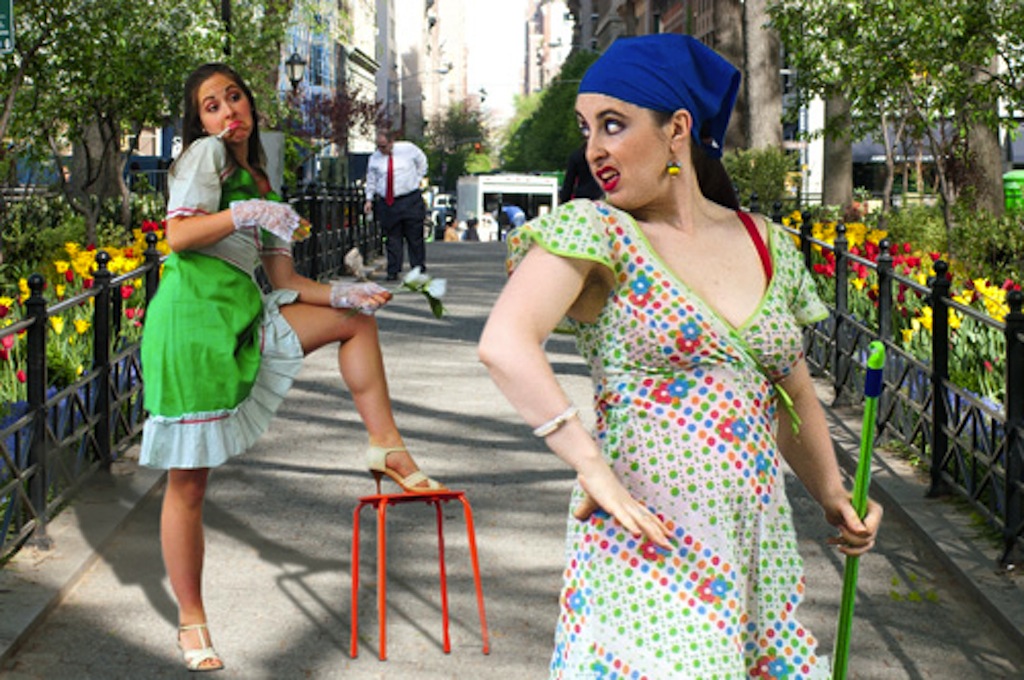
Anabella Lenzu/DanceDrama perform Ilusiones de Percantas (Women’s Dreams)

Although you might find her on 14th Street dressed as a maid, Anabella Lenzu is actually a dancer, choreographer, and teacher with 20 years of experience under her belt. Naturally, we were quite pleased to have her join this year’s Art in Odd Places festival because of her unique brand of “socially-conscious dance theatre”. Originally from Argentina, Anabella Lenzu has performed and taught dance all over the world. She currently teaches at Peridance Capezio Center, Wagner College, and Lehman College, and in November, she’ll publish her first book: “Unveiling Motion and Emotion”.

We caught up with the very talented Anabella Lenzu to chat about her project for the Art in Odd Places festival: Ilusiones de Percantas (Women’s Dreams).

AiOP: Tell us a little bit about your project.

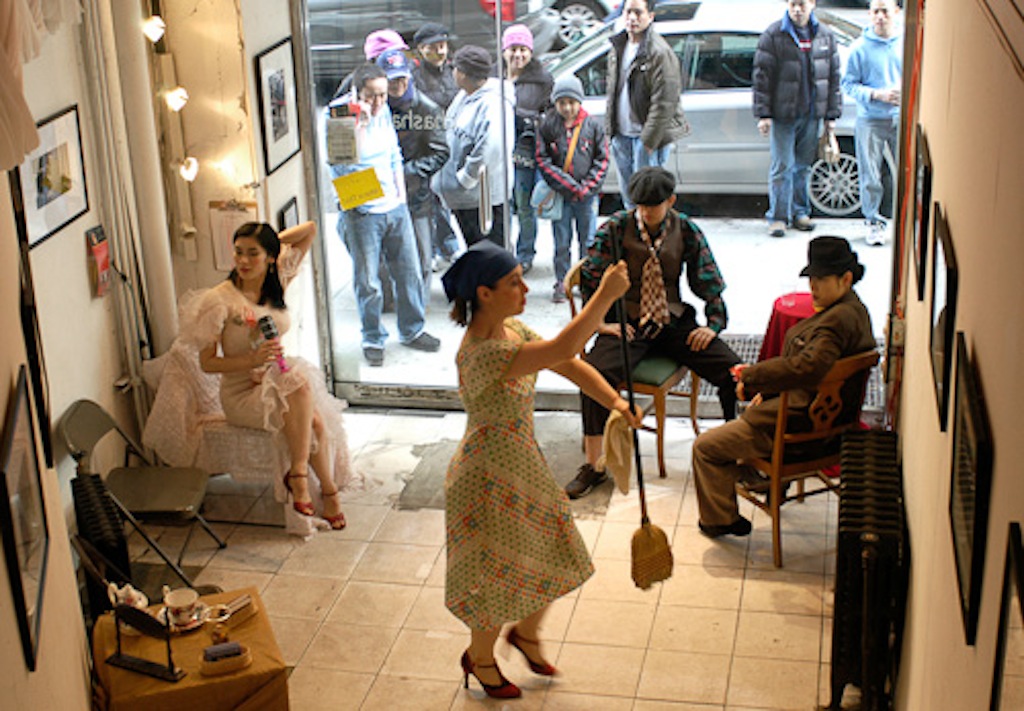
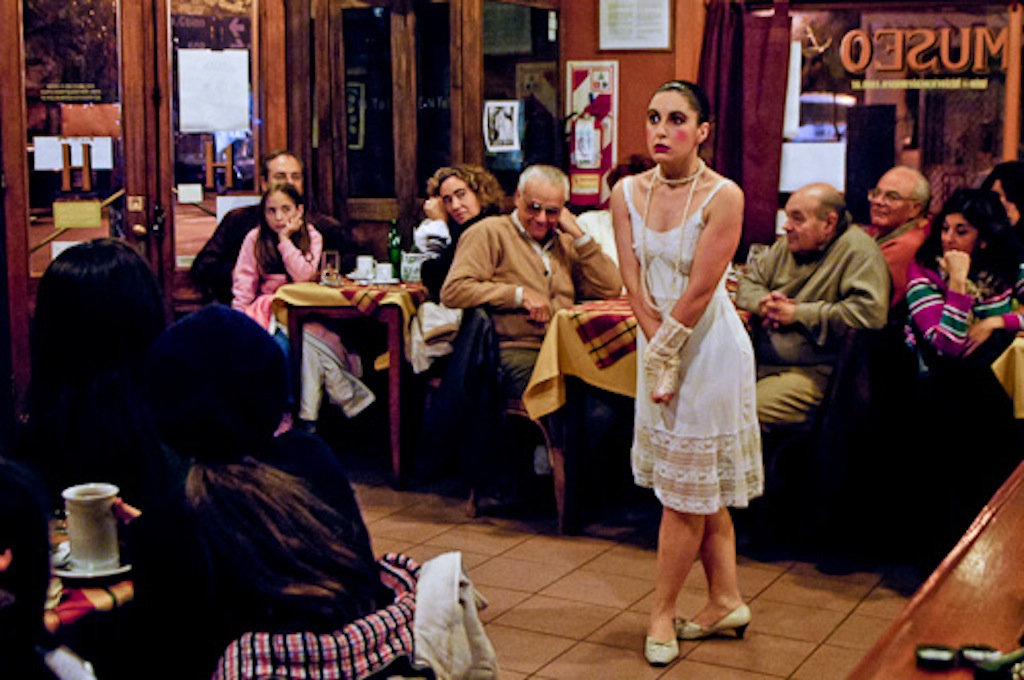
Anabella Lenzu: “Ilusiones de Percantas (Women’s Dreams)” is an interactive experience, which engages the audience and the performers together in one world. Dressed in vintage fashions and dancing to Argentinean Tangos from decades past, each character represents a “female prototype,” which is as timeless as ever. Through the work, the women humorously dismiss their quintessential poses to reveal their true selves. The piece is a direct communication with the audience through the character’s dance gestures that invoke an air of common experience. “Ilusiones de Percantas” is ideal to be performed in Union Square, because passersby can literally share common ground with the performers and see not only the world of Argentina in the early 20th century, but also glimpse deeper into their own lives.

Ilusiones de Percantas,” is an intimate, humorous, and grotesque work where music, theatre, and dance fuse. The archetypal characters described in the Tango lyrics, such as Margot (the prostitute), Pipistrella (the low-class housewife), and Palomita Blanca (the young tease) come to life through the rhythms of various Tangos, Milongas, and Waltzes.


AiOP: What interests you most about public art/performance art?

AL: From the chaos of daily life, Anabella Lenzu/DanceDrama distills the pure essence of real experience, real feelings, and real people. DanceDrama is the magnifying glass that reveals and examines emotional histories. Dance is union and communion with ourselves, with others, and with the environment.

I celebrate, meditate, respond, protest, explore, scream, cry, and laugh about life through dance. I interact with the time and space in which I live. My work is: intimate, audacious and historically/socially conscious. I testify to life through dance. I use dance to inform the audience about the role of the individual in society, and make the audience experience, feel, think and emote.

The black box theatre and the site specific work allows me to shatter preconceived ideas about life and momentarily transcend awareness of our present condition.

My repertory consists of solo work as well as ensemble pieces influenced by the flavor of ethnographic folk traditions, ballet and traditional modern dance. From this history, I am creating a vocabulary of meaningful movement that springs directly from emotions with visceral strength.  I organize layers of character-driven drama, and break apart quotidian social gestures.

I am building a repertory that offers a unique perspective, and testifies to the following themes:

• The relationship between the individual and society: communication, identity, memory and spirituality.
• The relationship between People and Environment.
• Women’s concerns and beliefs. The struggle for her identity and role in society.
• The nobility of the body as a temple for our mind, soul and heart.


AiOP: What are some of the more challenging aspects of your project? What makes it special?

 AL: While creating “Ilusiones de Percantas,” I was fascinated by use of quotidian gestures—the gestures that make up our daily lives and influence our interactions with the people around us. Throughout you will see gestures plucked from the ordinary events that help make life meaningful.

The dance is also filled with gestures that exist outside of particular events and have acquired meaningful associations through everyday use, such as obscene gestures or gestures of friendship, love, and family. These gestures represent a space where community can come together to experience collective excitement, joy, and anticipation.

Francois Delsarte, whose method of connecting inner emotional states with gesture influenced a legion of pioneer modern dancers, explored the principle that motion creates emotion just as emotion can be a source for creating motion. Likewise, I feel that watching meaningful gestures has the power to fill the viewer with myriad emotions and act as a source for emotional reflection and investigation. Watching the dancers perform obscene gestures, essentially degrading themselves on stage, immediately fills the observer with a sense of revulsion, anger, and discomfort. Harnessing those emotions through dance creates an opportunity to turn inward. These gestures are stark ways of expressing power, humiliation, sexual oppression, and adolescent bravado, which reveal a society forced to communicate through brutality.

Delsarte wrote, “Every gesture is expressive of something … It is preceded by and given birth by a thought, a feeling, an emotion, a purpose, a design or a motive.” Each gesture is created and preceded by an inner thought or emotional state, which is influenced by one’s cultural heritage. In  Ilusiones I have relied on many folk gestures as well as gestures from tango and other traditional dances. These folk dances explore the idea that culturally-created movements are made meaningful through habitual practice. In every society, one finds series of routine gestures, which sociologist Pierre Bourdieu explains through his theory of habitus.  Habitus describes the acquired forms of thought and action that one builds into bodily practice through living and learning in a particular culture. Eventually these repetitive motions become habituated. However, individual movement within a society constantly transforms even the most habitual motion. Thus, one can see quotidian gesture as both subjective and objective, created from within and simultaneously imposed from without, creating the space around us and filling it with meaning. The gestures built into  Ilusiones de Percantas explore this tension between inner thought and outward expression, creating a richly layered movement vocabulary that comes to life onstage.

Excerpts of Anabella Lenzu/DanceDrama performing “Ilusiones de Percantas” in the chashama window on 37th Street in New York City, 2007.

 Finally, check out Anabella Lenzu at these upcoming events!

Upcoming Performances

SANGRE & ARENA (Blood & Sand)
October 24, 26 & 28 at 7:30pm and October 27 at 4pm
at Wave Rising Series at White Wave John Ryan Theater, 25 Jay Street, Suite #100, Brooklyn, NY 11201
Tickets: $18 in advance $25 at door

Choreography:Anabella Lenzu
Music: Geoff Gersh
Dancers: Lauren Ohmer, Julia Lindpaintner & Anabella Lenzu.
Vocal Coach: Daniel Pettrow.

Sangre y Arena is a visceral piece of dance-theater that reconnects with the primal impulses that underlie ritual, juxtaposing intellect and instinct.In this interdisciplinary, multimedia production with paints and masks, Lenzu rediscovers ceremony and heritage.