Presenting visual and performance art in unexpected public spaces.

Christy Speakman: Eyes Wide Open

by John Critelli


Do you ever stop and think about the oil stains on the road?

Probably not – but Christy Speakman does.  And to her, they’re works of art.

“I want to be an advocate for the micro, the human, the specific, the individual, the numbered, the ephemeral and momentary,” she says.  And she does a great job.  Who else would notice the resemblance between those oil stains and distant galaxies?
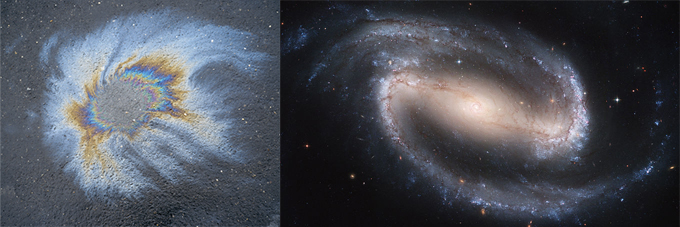
On the left is a photo from Speakman’s 2009 project Cosmic Territory.  On the right is a Hubble telescope photo of a barred spiral galaxy.  The similarities are clear once they’re pointed out, but the fact that someone has to point them out shows just how much we take for granted.

That’s why Speakman’s work is all about gaining a fresh perspective.  “Photography can teach us to live in the moment with our eyes wide open,” she says.  “Patterns and forms found in the everyday can be something more.”

Even something as simple as moss can become fascinating.  Speakman’s 2010 project, Moss Map, portrayed patches of moss as islands floating across the sky.
But it’s not just everyday objects that get overlooked.  Environmental problems are ignored too.  That’s why Speakman’s new project, Watershed, is all about the Louisiana wetlands.  Speakman, a New Orleans native, moved to New York after Hurricane Katrina.  But she’s still concerned about what she calls the “environmental urgency” of coastal Louisiana.

Watershed combines Speakman’s wetlands photography with 3D imaging.  The result is like a video game, letting viewers move through a surreal landscape where Speakman’s photos hover as spheres.  She says she hopes the project will “raise consciousness about the fragility and importance of coastal Louisiana.”

Speakman created Watershed for the United Secret Society of Subversive Artists (USSSA), a political art collective.  Read below for an abridged interview about USSSA, Watershed, and more:

AiOP: Tell us about USSSA.

Speakman: USSSA is essentially a movement and a revision to the art exhibition model, striving to create more opportunities, fairness and diversity for artists.

It’s also an educational forum where artists can bring voice to any political theme of personal/cultural relevance. Artists in the USSSA are in hope of reaching an audience and generating support for projects during the months leading up to the Presidential Election, which too often overlooks these important issues for storylines, gossip and dynamics between candidates.

A still from Watershed

AiOP: What makes the Louisiana wetlands a current political issue?

Speakman: After Hurricane Katrina, the state created the Coastal Protection and Restoration Authority that recently released the 2012 Master Plan outlining detailed projects over the next 50 years at an estimated cost of $50 billion.

Louisiana congressional members are still seeking approval of the RESTORE Act, legislation that would designate billions of dollars in Clean Water Act fines from the 2010 BP oil spill to fund Gulf Coast restoration projects.

There’s an urgent need for political support to bring these projects to fruition. Louisiana has lost nearly 1,900 square miles of land since the 1930s and the Master Plan says the state will lose nearly that amount by 2050 if nothing is done.

Doing nothing comes at an even larger price tag and affects our entire nation’s energy supply, not to mention the cultural losses that would incur.

Another still from Watershed

AiOP: Can you walk us through the development of Watershed? How did you get the idea, and how did it grow?

Speakman: The Louisiana swamp will always be my home and where I gained my intuition as an artist. Walking through a floating forest, you realize how intricate the surface of the water is, there is so much texture everywhere.

In 2007, I was an artist-in-residence at A Studio in the Woods, a bottomland hardwood forest within the city limits of New Orleans. During my research there, I started to grasp the environmental urgency of coastal Louisiana’s precarious state.

I originally envisioned making a more traditional documentary but was inspired by watching my husband design and build video games. I decided to borrow from that innovative technology and use UDK software to create an interactive piece that offers a more direct experience of looking at this incredible landscape.
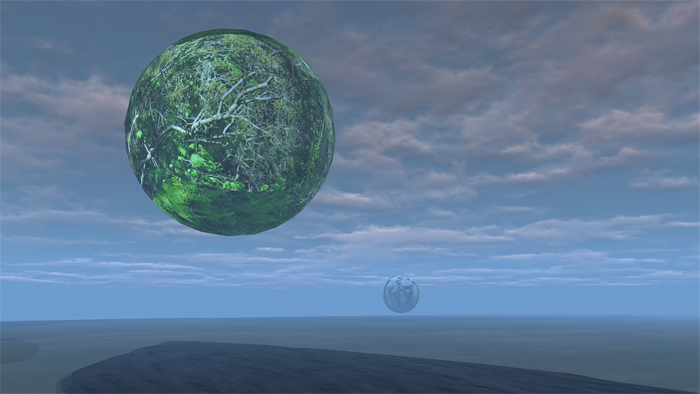
 

Another still from Watershed

AiOP: Why do you think perspective is such an important subject to explore?

Speakman: Where we stand connotes power. It was especially heart-breaking to watch news footage of New Orleanians trapped on rooftops while we were safely evacuated after the storm.

We’ve since become so accustomed to looking at images taken from airplanes, where everything is abstracted and map-like. I want to show people what that looks like on micro level.
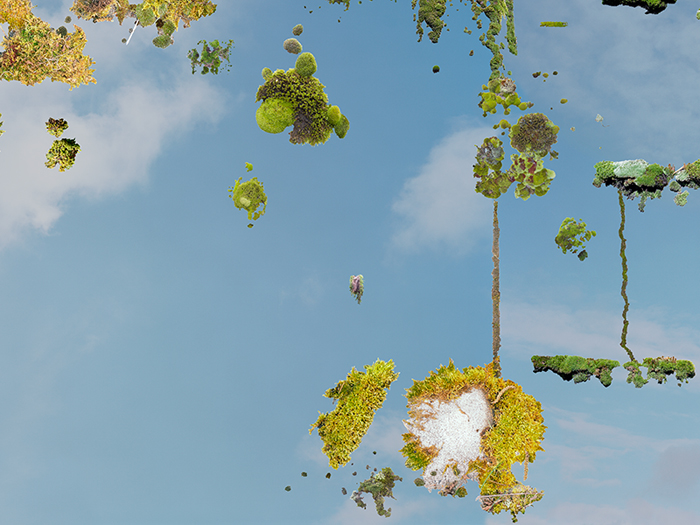
A close-up of Speakman’s 2010 project Moss Map

AiOP: For Cosmic Territory you described oil stains as “microscopic galaxies.”  For Moss Map you portrayed patches of moss as islands scattered across the sky.  Why do you think you see everyday objects in such a unique way?

Speakman: My relationship with photography has always been rooted in a desire to call attention to small pleasures. Almost everything I do comes from simply observing and paying attention.

I am fascinated at how an oil stain on my street can for a fleeting moment resemble a distant galaxy. I use photography to create new worlds, or call attention to the magic within our own – a fantasy within grasp. There’s definitely an element of day-dreaming involved.
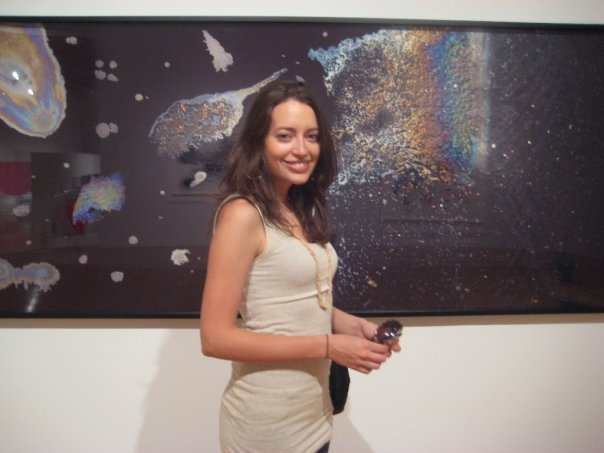
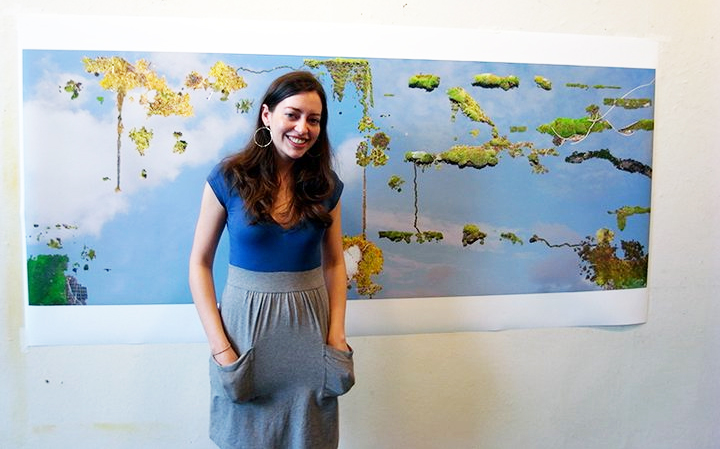
Speakman standing next to her 2009 project Cosmic Territory

AiOP: You’ve said that “Satellite mapping, astrophotography and Google Earth have notably influenced” your views. Can you explain how?

Speakman: Google Earth played an enormous role in Hurricane Katrina. After the levees broke the city shut down for months. Plugging your address into Google Earth was the most accurate way to measure the flood levels of your home.

Many displaced New Orleanians collectively experienced the storm this way. There was also the now iconic image of Katrina spinning towards the gulf in the often replayed weather forecasts that I could not get out of my head – originally sparking the idea for my oil stain photographs while wandering around NYC in the rain.

Years later I began studying cosmology and astrophotography – which has become a kind of postmodern mysticism for me.
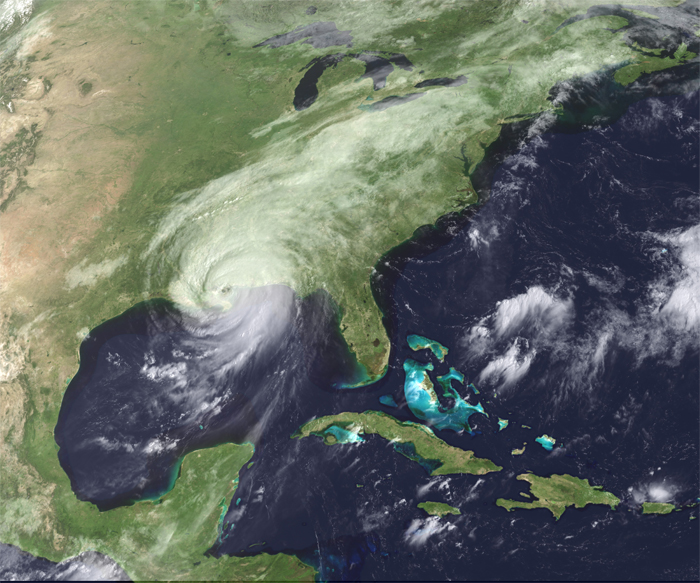
A NASA satellite image of Hurricane Katrina

Note: Speakman needs funding for Watershed.  Please check out her Indiegogo campaign, which ends Monday, June 25th at midnight!
23 Skidoo: Putting a Literal “Flash” in Flashmob

by Chelsea Keys

I walked into Pork Pie Hatters on 9th St. and Ave A to a wide variety of hats: felt, straw, fedora, feathered, some looked old and some looked new, all looked like they belonged in the early 1900’s. Here I met Shandoah Goldman, choreographer and producer of a new project called 23 Skidoo and her costume designer, Asa Brown Thornton.

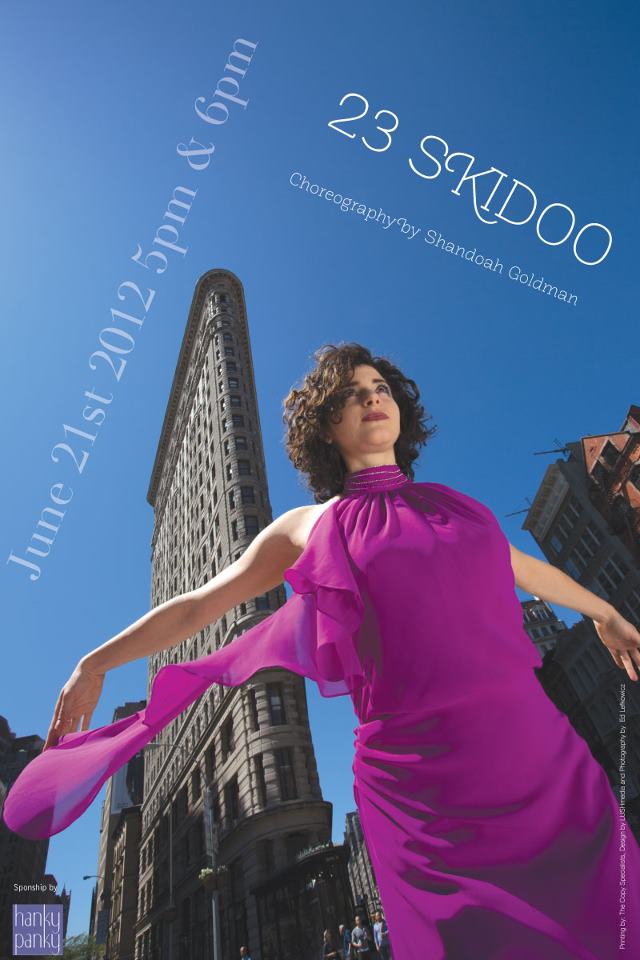
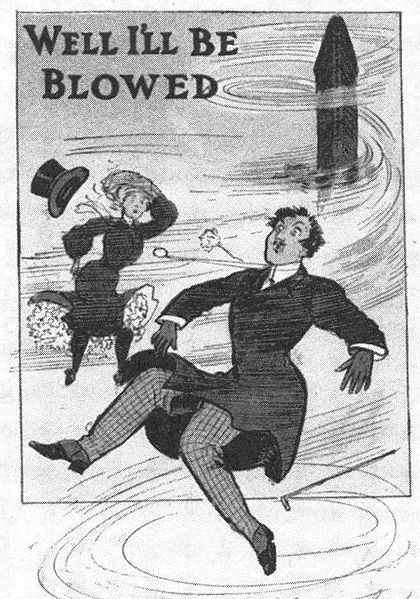
Pork Pie agreed to sponsor the project so the two were picking out 11 early 1900’s inspired hats for the 11 men performing in the outdoor flashmob set at NYC’s Flatiron Building. The project was inspired by the wind tunnels that existed around the Flatiron Building in the early 1900’s that would blow women’s skirts up, revealing their legs, which were rarely if never revealed. Men would gather around the area to see the phenomenon if not shooed away by cops who yelled out “23 Skidoo!”

After shopping I sat down with Shandoah and Asa to talk more about the project:

AiOP: Tell me a little bit about the work and your inspiration: why you decided to do this work now?

Shandoah: I heard about the image of 23 Skidoo years ago walking by the Flatiron and one time someone mentioned to me that women used to walk by and their dresses would fly up by the wind.

Courtesy of Wikipedia

I found that really fascinating so last year at some point I had a sudden vision of a flashmob of hundreds of women performing this image. Then I found out that it was the 110th anniversary of the building and I thought I have to this this year in 2012. I thought I could do it as a flashmob and tell people to come at a certain time and make it spontaneous but then I thought how much cooler it would be if it was choreographed and had it more planned and tell the City of New York that I was doing it and make it a New York City event.

AiOP: How do you expect random people walking by to react?

Shandoah: Well we did a photoshoot down there with 5 women in long dresses with a photographer and judging by that it was pretty amazing how many people stopped and took pictures. I think anytime something out of the ordinary happens on the street people want to know about it.

AiOP: Did people ask about it? Did they ask about the story?

Shandoah: They mostly joined in and took pictures. It’s kind of just New York where sometimes nothing really surprises you. But I think what the most striking image will be how many women are involved.

AiOP: What is the movement like?

Shandoah: A lot of it is unison so it’s very clear that it’s a set choreography rather than something spontaneous. There is some structured improvisation but it’s definitely structured.

AiOP: Can you tell me a little bit about your previous work and how that does or doesn’t relate to 23 Skidoo?

Shandoah: I have always loved site specific work and I would say that my work in the last few years has really strayed away from the stage and become more site specific. I’ve collaborated with video artists and have become more into working with location. This project was even more in depth in that regard because the building created the wind pattern which created the story which created this movement so I feel like it’s a really great site specific work because it couldn’t be done anywhere else and the movement is really based on the phenomenon that happened with women’s skirts flying up in the wind. This is the biggest work I’ve ever done and it’s also the first project I’ve self-produced.

AiOP: How much did the city know about your work? Was this an important aspect in creating it?

Shandoah: I started out with a really big vision of this being a large New York City event that everyone knew about. I’m still not really sure who knows about it but it was really interesting reaching out to people not in the dance world, such as the NYPD and the Business District around the Flatiron Building. So hopefully many people that are not in the dance world will come to watch the piece.

AiOP: Do you have an intended message for the work? Are you exploring any larger themes?

Shandoah: It’s really about the transformation from where we’ve come 110 years ago and how it was so taboo to show your legs and that men found that so fascinating. Now, there’s not really anything too taboo. So I’ve been researching that and what’s been happening culturally over 110 years. It’s a pretty bold statement for women to be able to show their legs and in this case to actually show their underwear (designed and sponsored by Hanky Panky) and I think when you see all the women doing that together it’s really powerful. It’s a really strong statement. So in a way it wasn’t intended to be a women’s liberation statement but it does carry that vibe. I’ve also been researching what it’s like, culturally, for a man to be able to watch a woman and what’s accepted. It’s very different in other cultures than it is here. 110 years ago cops would arrest the men who stood around the building to watch the women’s skirts fly up. So the term “23 Skidoo” came from the cops telling the men watching to get out of there. Then if they didn’t leave they would get arrested. So even then it wasn’t accepted but it was their way of sneaking a peek of something that was really taboo. Then visually, I love the idea of the wind and this weather pattern in an urban landscape creating that image.

AiOP: Do you see any connections between that time period and this time period?

Shandoah: Style-wise, this early 1900’s look is having a revival. It’s a really classic look. We had a little trouble shopping for dresses that were as long as we wanted.

Asa: Yeah, we played with a lot of different ideas: everyone being in the same dress or getting a really modern dress to contrast the scene. But Shandoah kind of had this image of a cocktail party where everyone is in a different dress but the length is the same. We shopped at Goodwill and Housing Works and anywhere that was inexpensive. We changed dresses and colors and necklines depending on the people. The dresses are mostly black but with groups of brightly colored dresses. They’re doing so much unison movement that we decided on different dresses. Same party, different dresses.

Shandoah: The women are also wearing heels. There’s a lot of running in the piece. There’s no music except for a little a cappella bit in the beginning with 3 guys. The sound of a day on the street and the heels as an important factor. We’ve been working on how wearing heels affects the movement and how being a woman caught up in the windstorm wearing heels affects reaction time. Soundwise, the heels become cues for certain movement at certain times.

AiOP: What’s the mood of the piece? What are the dancers supposed to emote?

Shandoah: I’ve been playing a lot with sarcasm. The women make their own dresses fly up and say “Oooh it’s windy!” So it’s like they expected it yet they act surprised. There’s this book called The Flatiron that has a chapter about 23 Skidoo. It talks about how women started to realize it was a windy corner. They would go down there and want the wind to blow up their dresses and when it didn’t they were disappointed. So that was something I was working with- exaggerating the phenomenon. There’s been a lot of interesting synchronicity with what I envisioned this project to reveal and what really happened. In the original rehearsal process at Joyce Soho we talked a lot about what it feels like if a guy catcalls at you. One woman in the piece came to me and said she was uncomfortable revealing that much leg and I reminded them that the feeling wasn’t supposed to be personal it was supposed to be replicating this historical event. That became the theatrical part of this dance piece. I’m really asking the dancers to explore what happened then and present that image rather than their personal feelings about it.

AiOP: What do you want audience members to take away from this performance?

Shandoah: I think it’s a really sexual thing- hiding underneath clothes and what’s hidden and exposed and the gender relationship of men wanting to see women’s legs. I think it’s present in our culture in many different ways and I think it’s interesting to see it in a historical context and realize that it still goes on now. There’s a repressed sexual intention- the women want the men to see their legs and the men want to see them but it’s not OK.

Asa: One of the images I was working with when thinking about costumes was a woman getting onto a streetcar and you can see her ankles. There’s a man next to her ogling her. And it’s weird to think that to us, that’s nothing. But if you relate that to modern times,  if a woman showed her breasts (which is legal in New York), men would still react in shock.

Shandoah: I think these stories and themes talk about the body. As a choreographer and dancer I think about the body in a theatrical context. This piece explores what’s hidden and what’s revealed and the taboo that surrounds the body. I think as a culture we’re drawn to those things that are taboo. The audience members in the piece, in my mind, are actually replicating the men who would stand around and watch the women’s skirts. There’s also a section in the beginning called “Directing Traffic” where the women invite the “men” to watch then say go away then invite them again.

AiOP: Maybe talk a little bit about how this piece fits into the larger “art in odd, unusual places” theme.

Shandoah: Another part of this project is that I quickly decided not to wait for a venue to produce this work. I wanted to find a venue that would be big and visible and thought I would just work on literally representing the historical event at the place where it happened. Only in New York would the NYPD say yes and close the 190 feet of sidewalk and the business district support it. I’m making the sidewalk the stage.