Presenting visual and performance art in unexpected public spaces.

Laura Napier – The Motor City Window Washing Co.

The Motor City Window Cleaning Co. combines a tale of two cities with an artist’s own unwinding family history. Artist Laura Napier joins us to discuss the project and the family secret to washing windows (Video below).

Tell us about yourself. Where are you from and what’s your connection to Detroit? 

My great-grandparents came to Detroit from Poland in the early 20th century, and both my parents grew up in the Detroit area, but migrated west with their families to Arizona and California in the sixties. I was born in California, but have lived in New York City for almost twenty years. That is a lot of migration over four generations! I have been in Poland, but have never gone to Detroit. So it is a mystery to me.

 What inspired the Motor City Window Cleaning Co. project? Why bring your grandfather’s window washing company to Memphis?

Only recently have I seen a family tree. It reaches back to the Ferenc family farm in Poland. The Motor City Window Cleaning Co. is part of that story, and it has been fun to call up relatives and ask them what they recall about it. Everyone in the family still knows the secret to washing windows is to just use a lot of water, and to have good squeegees, shammies, and maybe a little ammonia. Now you know the secret, too.

I was invited to do a project for the exhibition Memphis Social, curated by Beautiful Fields in May, at many places across the city. On a scouting trip to Memphis I was struck by the names of businesses on signs, like Arnold Hearing Aid, or Easy-Way (a vegetable store). It seemed apt to add Motor City to that list as a kind of absurdity, and also, window washing is a great envelope for social activity.
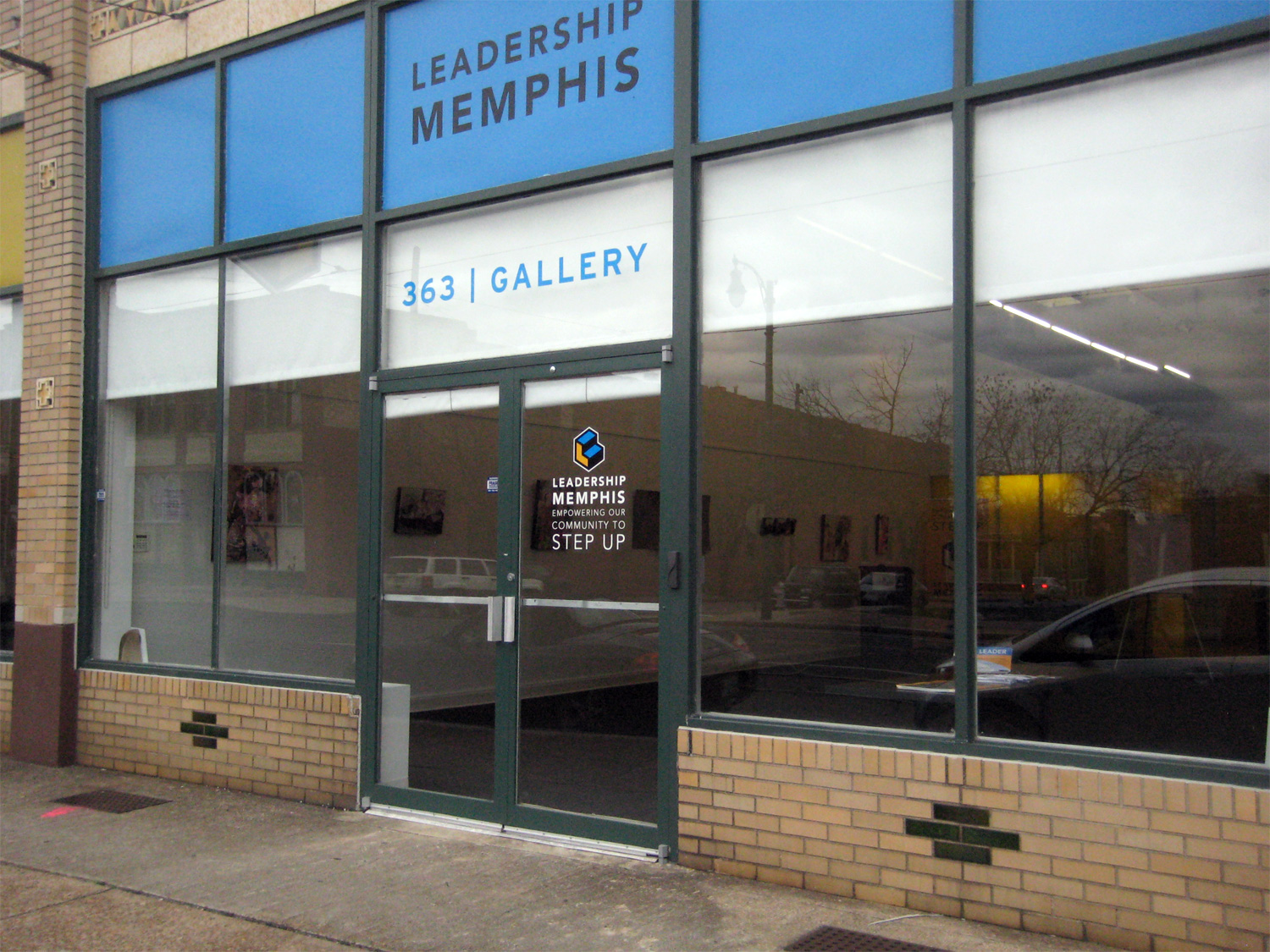
 One of many storefronts on South Main, one of the areas included in the Memphis Social exhibition

Have you discovered any interesting comparisons between Memphis and Detroit? Have you discovered anything interesting about your family’s history by exploring the history of these two cities?

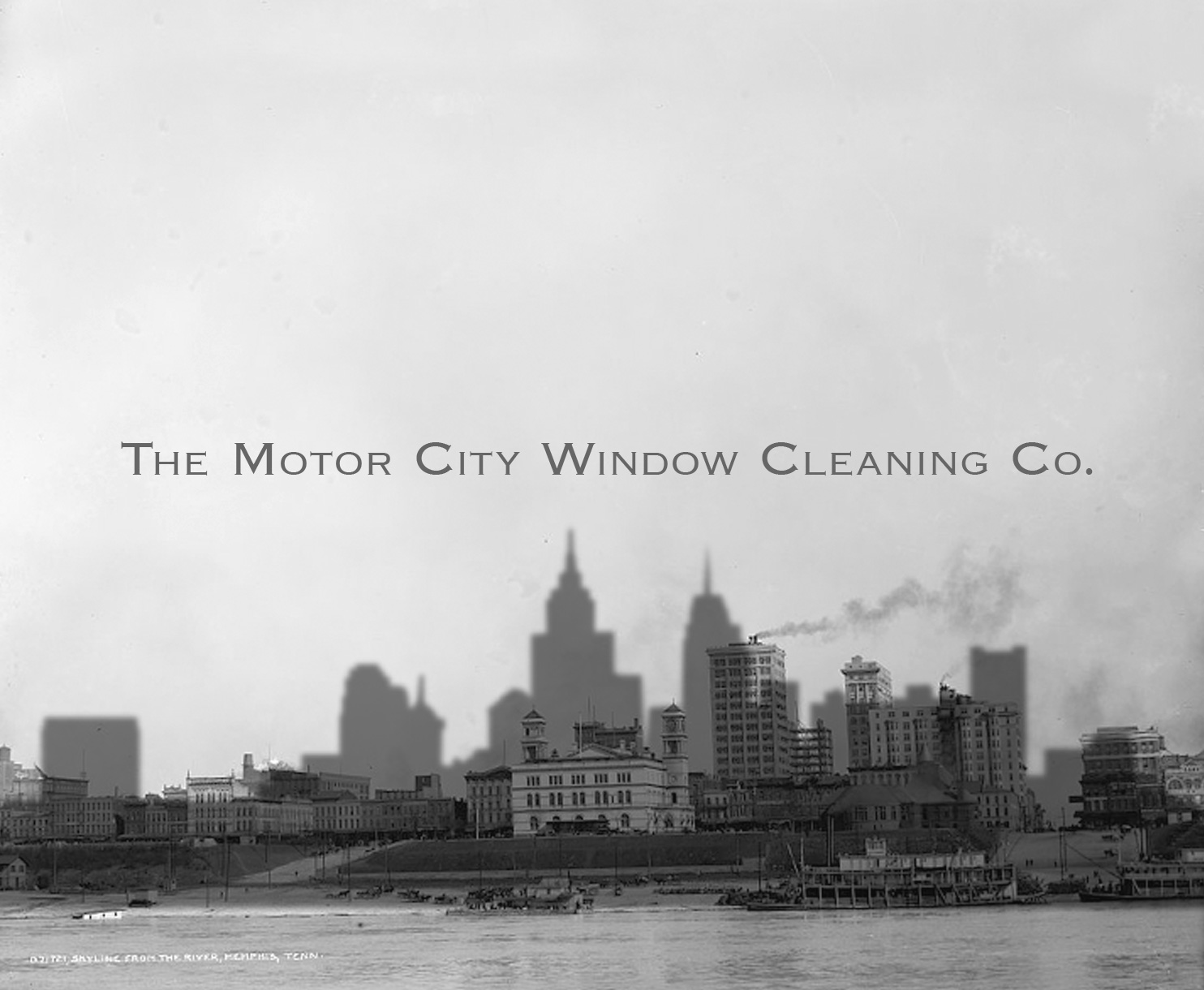
There have been some interesting coincidences. While searching the Library of Congress for a photo in the public domain of the Memphis skyline, I found one circa 1900 – 1910 inscribed with “Detroit Publishing Co.”. And when I went to Memphis, I immediately met and spent some time with an artist originally from Detroit, Mary Jo Karimnia. Then there are the Memphis and Detroit Tigers.

Both cities were high on industry at one time (cars, cotton) but now are in economic decline, as one friend put it recently, they are both “busted”. Both cities saw tragic events during the civil rights movement, with Detroit forever changed by the 1967 riot, and Memphis with Dr. King’s assassination during the Sanitation Strike in 1968.

As far as I know, my family does not have any history with Memphis. It turns out that my father did see the smoke rising from downtown during the riots in Detroit; he was interning at Ford at the time. I knew that my family’s migration west reflected greater patterns of white flight, but didn’t know that he was still in Detroit at that time.

What themes or ideas do you typically toy with in your work? Do you find certain ideas easier to express than others?

Lately I am very interested in social groups, especially ones organized inside sites of former communities — where people lived or worked together. Usually these projects begin with primary and secondary source research.

In 2011 I staged Channel, an encounter group following an hour-long script of associative texts related to former Synanon and Baladullah alternative communities at the original site in semi-ruin in the California Sierras, which is now an art space called The Hatchery.

In 2012, the social project Activity Committee, created in collaboration with Carmen Julia Hernandez, invited artists to resurrect historically documented social committees with existing communities of workers, students, seniors, exhibition goers, and neighbors in and around the Andrew Freedman Home, a formerly grand private retirement home in the South Bronx now owned by the Mid-Bronx Senior Citizens Council.

I am also traveling to Flint, Michigan in late April for an early project with the Flint Public Art Project’s Free City festival. Happy Valley will be a special performance of The Flint Male Chorus, directly descended from the company era Chevrolet-Flint Male Chorus of the Chevrolet Manufacturing Division, and the Flint City Wide Choir, an interdenominational group from more than 50 churches across Flint. Both are performing outdoors at the Flint-Chevy site where factories once stood.

Due to their nature, these projects are complex. I am slowly working through the book Artificial Hells: Participatory Art and the Politics of Spectatorship, Claire Bishop, Verso, 2012 right now, because it posits a rich history of and theoretical framework around  this kind of work, from 1917 until today. While in graduate school, I was always struck by the nature of inclusion and exclusion, being in the know or not, in Ei Arakawa’s work staged in our small community during our studies. Being the organizer of my own projects, I am usually in the know, but this tension between knowing and unwitting participation is always present.
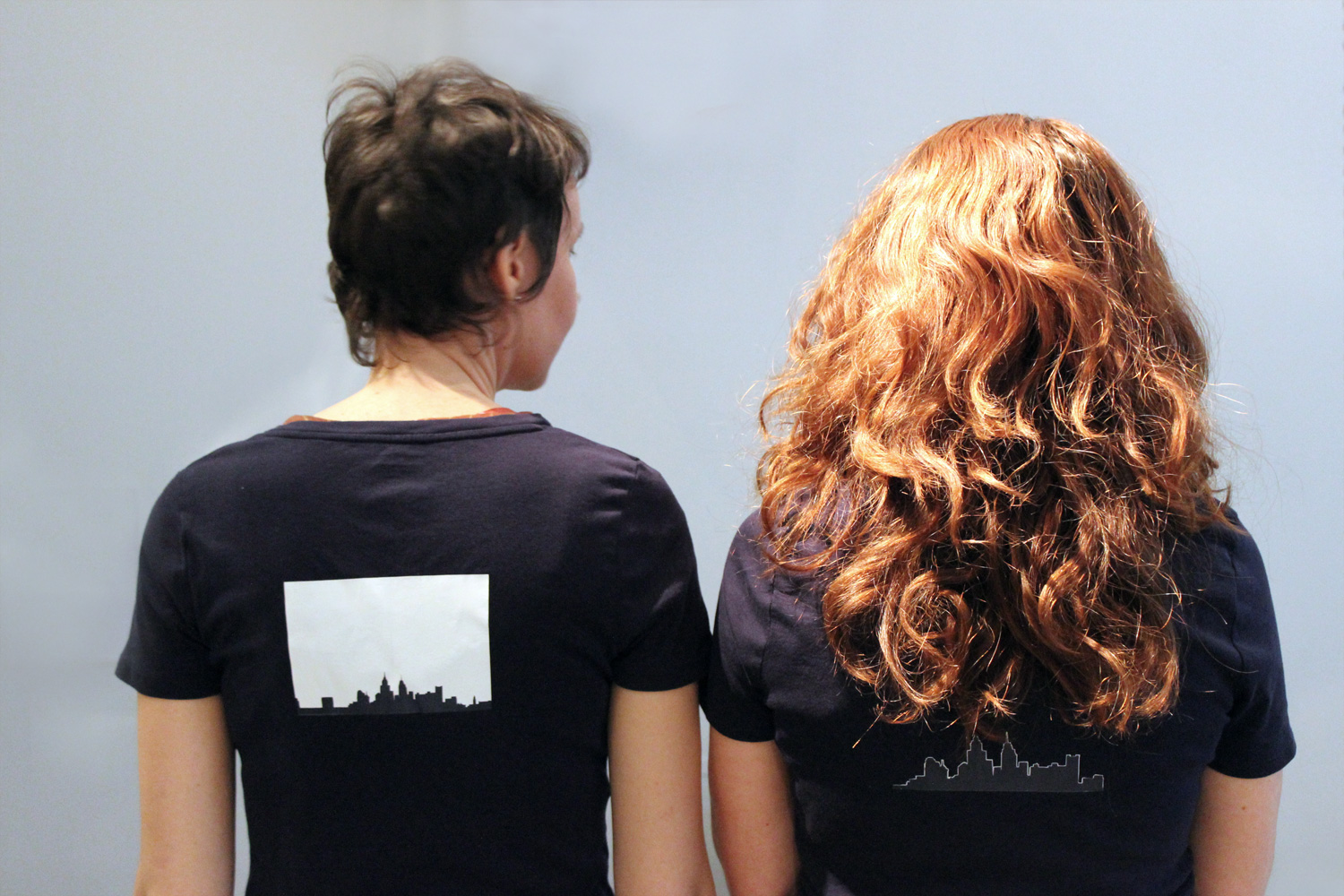
T-shirt prototypes in development for The Motor City Window Cleaning Co.

Many of your projects rely on participation. Why is participation an important element to incorporate in your work?

Recently I went on a walk to Houdini’s grave in Queens organized by Erin Sickler with a few other women artists, and the conversation at one point centered around what personal problems we were all trying to work out through our artwork. One person, who is a very good organizer of people, says she is super disorganized in her work space; another, a painter, will never be able to pin down what her paintings are supposed to do and be, so she is doomed to paint over and over again. It all sounded pretty productive to me. Living and working as an artist from day to day can be very lonely at times. It is a big reward to see the aha moment, when someone experiencing or embodying a project lights up with excitement; also, participants in my work usually know better than me what is going on, and have great ideas that I would never think of on my own.

Are you trying to evoke any particular emotions with this project or are you working through any particular emotions yourself with this project?

To be honest, the audience in Memphis, local residents of Memphis, gallery goers, passersby, and other artists who are part of the exhibition, when they encounter it may not know that The Motor City Window Cleaning Co. is an art project. Many of my projects rely on something unexpected, a surprise for the audience.

If anything, the research into this project so far has made me feel much more grounded as a person and as an artist, as I find out more about the personal and professional histories of my extended family. Understanding the themes and threads that have run through everyone in the family as a group has changed my thinking on my personal history as an individual.

Do you see a connection between the work you do as an artist and the work your grandfather did as a blue-collar window washer? What labor injustices do artists face today and how can they solve them?

There is definitely irony in raising funds through USA Projects to support what should be a for-profit business; art takes the profit right out. That said, every business needs startup capital, and art is no different.

Also, my opportunities personally as an artist are more blue collar, maybe because of where I came from. So it is funny to embrace that.

My grandfather’s clients were mostly furniture stores and the like along Michigan Avenue, and he never raised his prices after gaining a client, this is over years and years. When he sold his business circa 1964, the next guy was able to double prices overnight. My grandfather had been afraid to lose his clients if he raised his rates, and many artists are suffering from the same conundrum, afraid to lose their clients or opportunities. Often fee rates are handed to them from institutions and there is little leeway for negotiation. And those fees have remained frozen in time as the cost of living has shot up here in New York City. We should learn a lesson from the next guy.
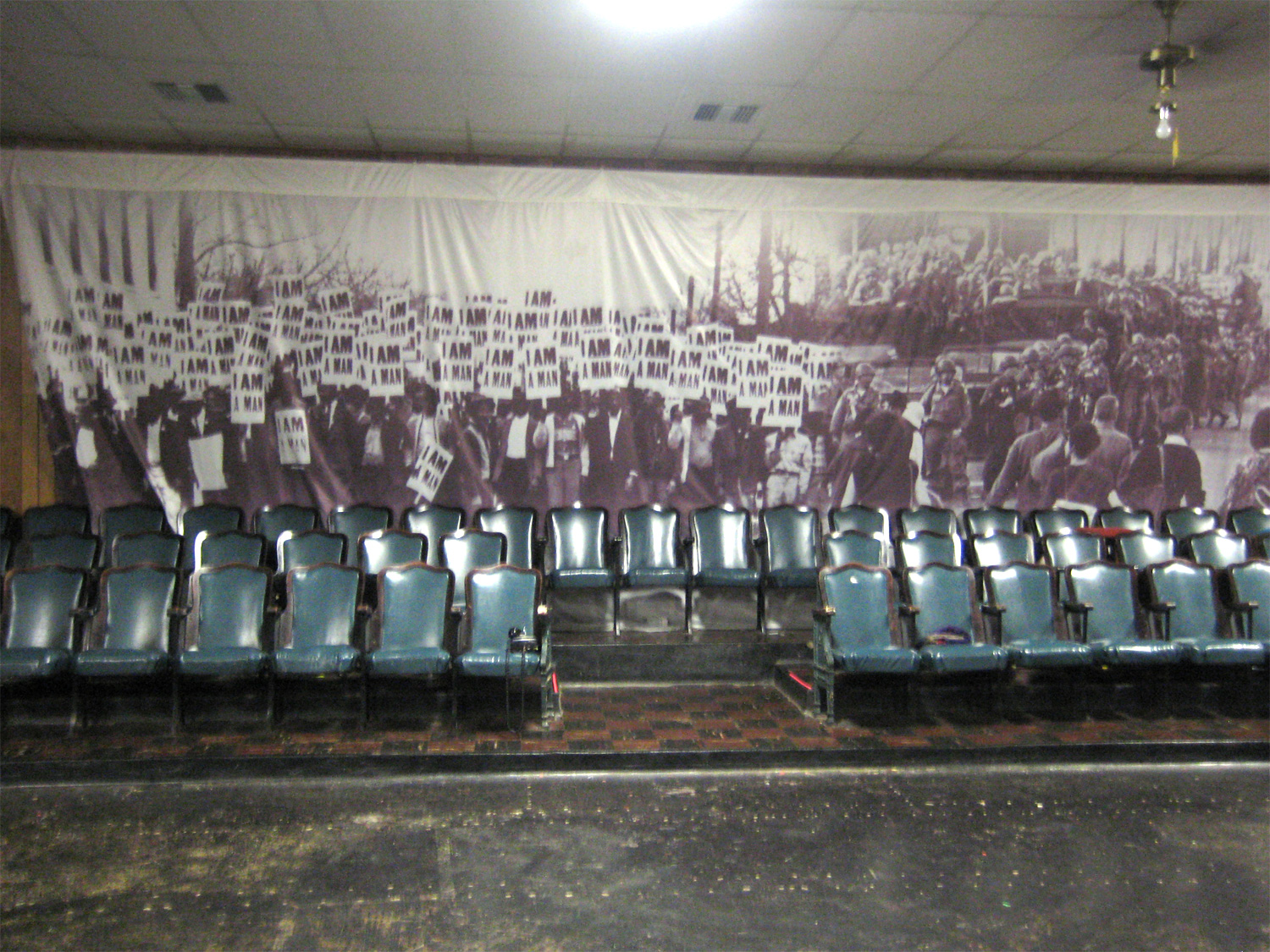
Caritas Village is a community center in a former Masonic Temple; famous images of the Memphis Sanitation Strike by photographer Ernest C. Withers are on permanent display. Incidentally, Withers was a paid FBI informant.

Anything else you want to add?

My grandfather supported everyone through the Motor City Window Cleaning Co., although according to my aunt he could’ve worked his way up in the office at GM. Instead, he worked as a night watchman at Fisher Body while starting up the window washing business.

Being the oldest, he dropped out of school around sixteen to support his mother and his younger siblings, and before then as a schoolboy he helped his mother at her job, cleaning offices early in the morning before school started. His father before him also washed windows. About this, a relative who researched much of the family tree wrote tactfully, “Before he made it home, Walter  [my great-grandfather] would often leave most of his hard earned paychecks at the local bar.”

My grandfather had an amazing retirement. I knew him as a very cheerful man in Arizona, who woke up early to feed the dog and wild birds and make breakfast, and who enjoyed playing cards, gardening, fishing, bowling, golf, and went on road trips in his giant Detroit built car to Reno, Nevada, where he and my grandmother played nickel slots.

He would insist on washing the windows in my mother’s house when he visited us in California. He painted my room a bright shade of orange when I was a child and it affected me for life.
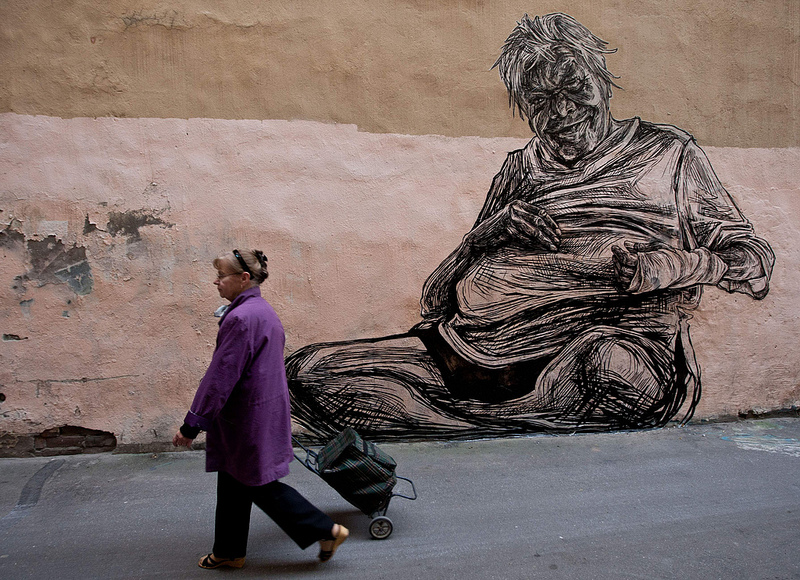
Art Prospect: First-ever large-scale public art festival in St. Petersburg, Russia

Ms. Bennett, Swoon. Photo by Evgeniy Luchinskiy.

By Matthew Morowitz

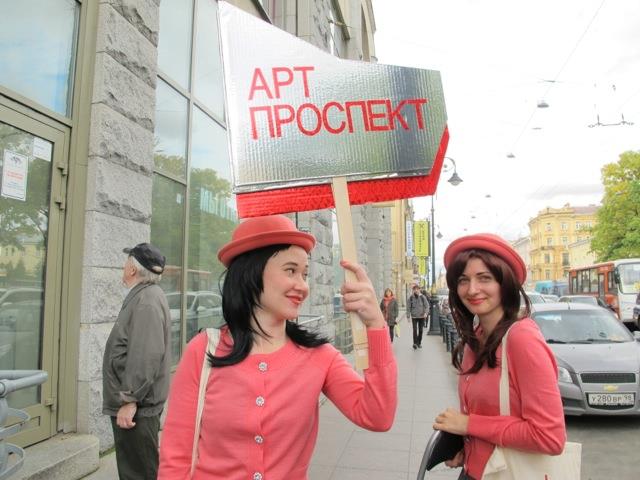
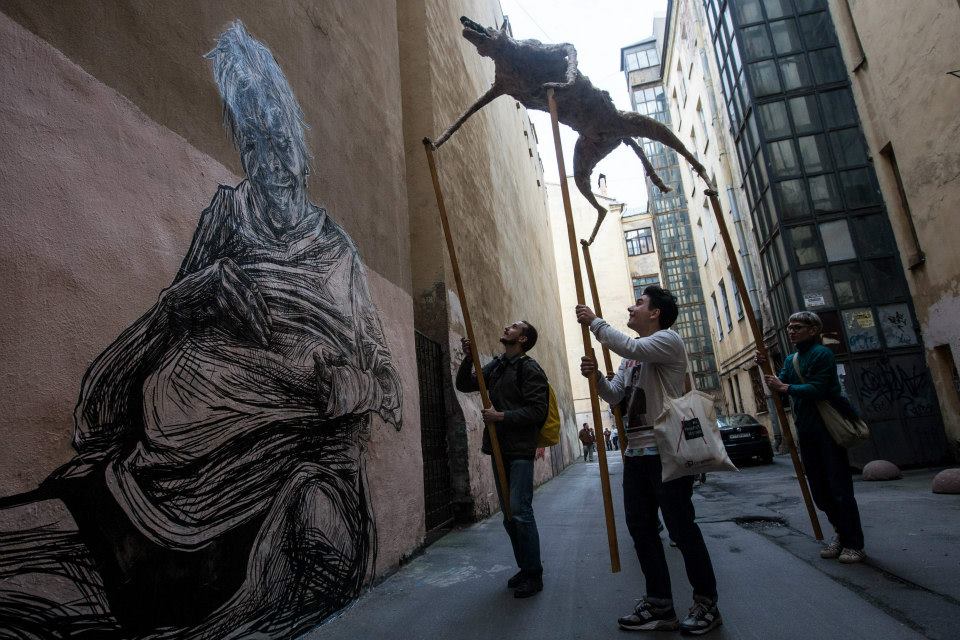
In September of 2012, a handful of American artists were invited to St. Petersburg, Russia to participate in the first ever large-scale festival for public art in the city, Art Prospect.  Although there have been other public art festivals in the city, Art Prospect differs from them in its size and location.  This four-day international festival was organized by CEC Artslink and co-curated by Ed Woodham, the director of Art in Odd Places (AiOP) and featured the works of seventeen American and Russian artists and art groups who “…share the desire to present art in unusual spaces, to cover a wider and more diverse audience…”

The projects, which included installations, video, performances, ephemeral objects, and other examples of contemporary art, were meant to attract the attention of the passersby, while at the same time relating to the spaces of Liteiny Prospect: the street, courtyards, cafes, storefronts, and facades of buildings.

The Soap Group’s “Dog” peeks into a window above Swoon’s piece “Miss Bennet.” Image courtesy of CEC ArtsLink.

Liteiny Prospect runs off of the main avenue of St. Petersburg, Nevsky Prospect, and the buildings of this avenue display an architectural feature that is particular to St. Petersburg: tunnel like passages that open into courtyards.  These courtyards are public spaces belonging to the city and function as community spaces for the residents and businesses of the people who live and work in the area.

Getting permission to do these types of works was one of the biggest challenges faced by the festival organizers; in Russia, putting together any kind of festival requires permits and approval from a number of departments from the city administration.  Since Art Prospect was the first ever large-scale public art festival attempted in the country, these governing bodies were wary about the kind of precedent an event like this would be setting.  Before the festival was even firmly set, CEC was in discussion with the city administration for almost a year, only receiving final permission and a list of courtyards that could be used one week before the festival’s opening.

All of the artists involved in the festival were described by Susan Katz, the CEC organizer who was the driving force behind putting the festival together, as “generally wonderful to work with” and very flexible when it came to adapting their projects “given the difficulties of working in Russia and the need to make many last minute changes.”  Over the last few months I corresponded with Susan, and talked with some of the participating American artists, including Ed Woodham, Nicholas Fraser, Terry S. Hardy, and Sheryl Oring, in order to gain insight into the overall experience of working in Russia and some of the public reactions to the pieces and performances that were presented.

Ed Woodham

Strange Makings, Ed Woodham with Pro Arte students. Photo by Evgeniy Luchinskiy.

For Ed, coming to St. Petersburg was not only an opportunity to share AiOP’s mission but also a chance “to create a subversive, gay expressionist performance as part of his Homopropoganda series.”  Right before Ed came, Pussy Riot had just been imprisoned and the governor of the city declared being gay to be illegal.  Having heard this news, Ed knew he had to do something “for his own well-being.”  So he took on the role of Fancy “a flaneur of sorts who was ‘out’ on the town,” donning an outrageous costume, a wig, flamboyant jewelry and, with the help of Terry Hardy, crafted a photomontage of his character walking the streets of St. Petersburg and posing throughout the city.

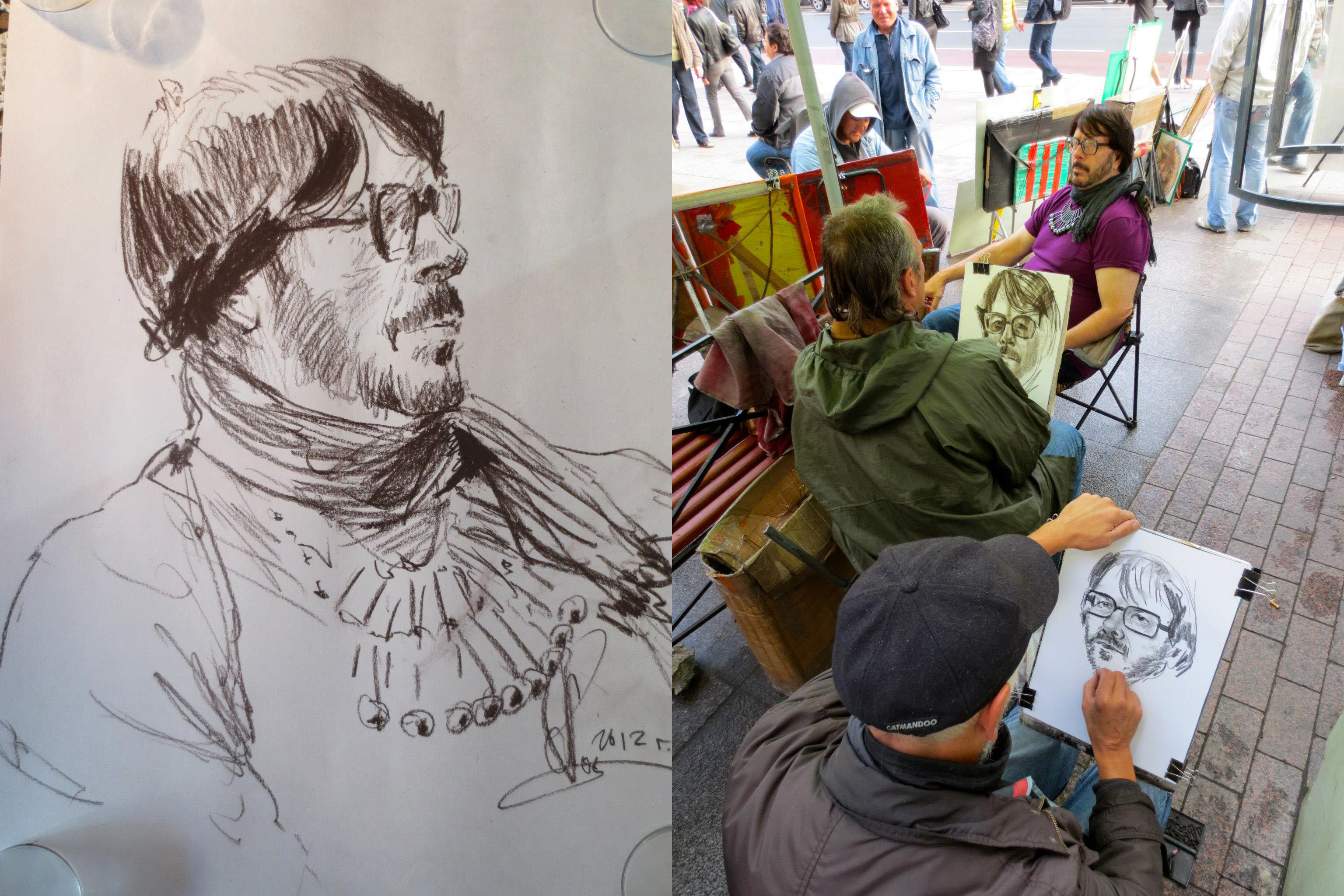
On his excursion, Ed came across a plaza where artists were selling kitsch paintings and sketching tourists, so he bargained with one of the artists, the only one who spoke English, to sketch him.  The artist agreed, asking him, “are you a rockstar?” and “what’s going on?” and as Ed was explaining he suddenly found himself swarmed by the other artists, who began to sketch him as well.  Ed became the epicenter of activity, as he was surrounded by all these artists who were sketching him, who were then followed by Terry photographing the scene and tons of Russian tourists gathering to see what was going on, creating “these concentric circles of modeling and observation.”

Sketch of Ed by Russian artist.  Ed being sketched. Photo by Terry Hardy.

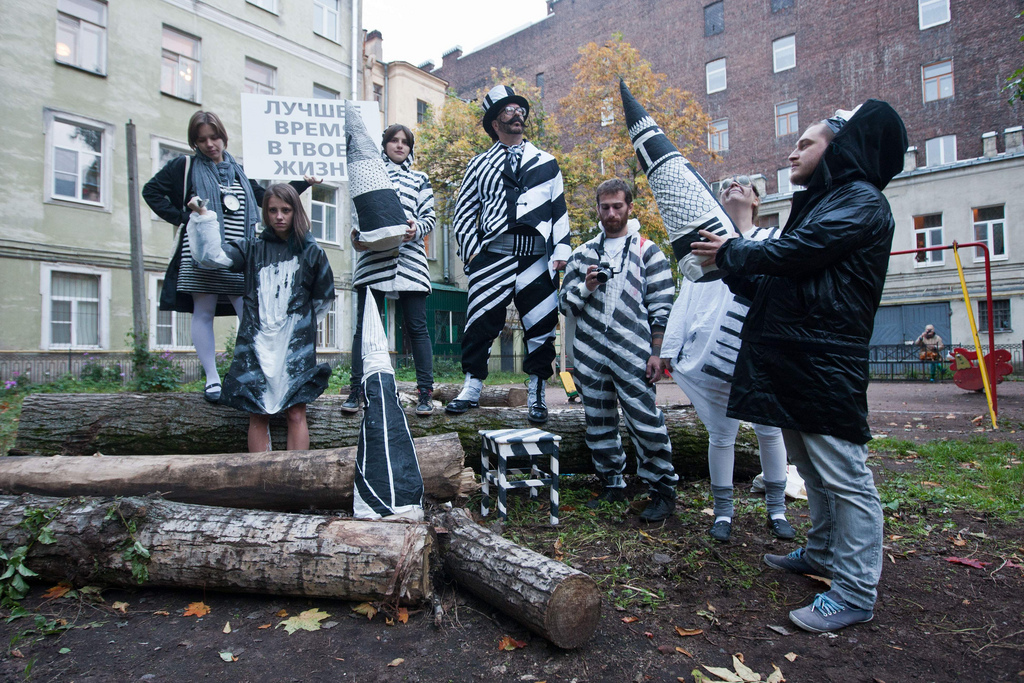
Ed translated what he learned from his excursion through the city into his performance for the festival, which touched on ideas of modeling and observation in a storefront window on Liteiny Prospect and involved the participation of students from the Pro-Arte Foundation in St. Petersburg.  On the opening day, the courtyard near the storefront where Ed presented his piece became:

“…exactly what we wanted to create, people were surrounding us, photographers, videographers, because we were very visual and they were doing for us what we were going to do for them.  They were surrounding, documenting us, photographing us; we were modeling from the very onset.  We modeled and wherever we would stop people would surround and photograph us.”

At this event everyone had a different way of working, drawing the attention of bystanders, photographers, and reporters from the national news, each of them taking pictures and video recording the actions.  In turn, these individuals were also being sketched and photographed by Ed and his students, “turning the play of who is looking at whom.” While a black and white striped outfit was the required attire (Ed’s garment was designed by veteran AiOP artist Gretchen Vitamvas), the students all took their own variations on the theme.  “One artist,” Ed recalls, “had a black costume and balloons inside of her costume with paint and she had a knife and she would stab herself in certain points in the evening and the balloon would leak out white paint onto her black dress.”

The next day was the performance in the storefront window.  The first impression Ed got from the observers was “a lot of stony, stoic faces” and as a result he made it his mission to “make them smile,” something he managed to accomplish successfully as the performance went into full force.  The piece, which involved participants and observers viewing each other, became more slapstick and visually funny as people gathered outside of the window:

“It became comedic and it was great to see these stoic faces break down, everyone laughed, everyone smiled, and people gathered around us and we photographed, videoed, and sketched them looking at us.  Also two artists from Amsterdam, who are curating this festival this year took hundreds of photos of people looking at us revealing the passersby’s expressions.  People were looking; from busses, on the street, [even] to people in cars honking, [they were] gawking at the spectacle in the window.”

Nicholas Fraser

Photo courtesy of the artist.

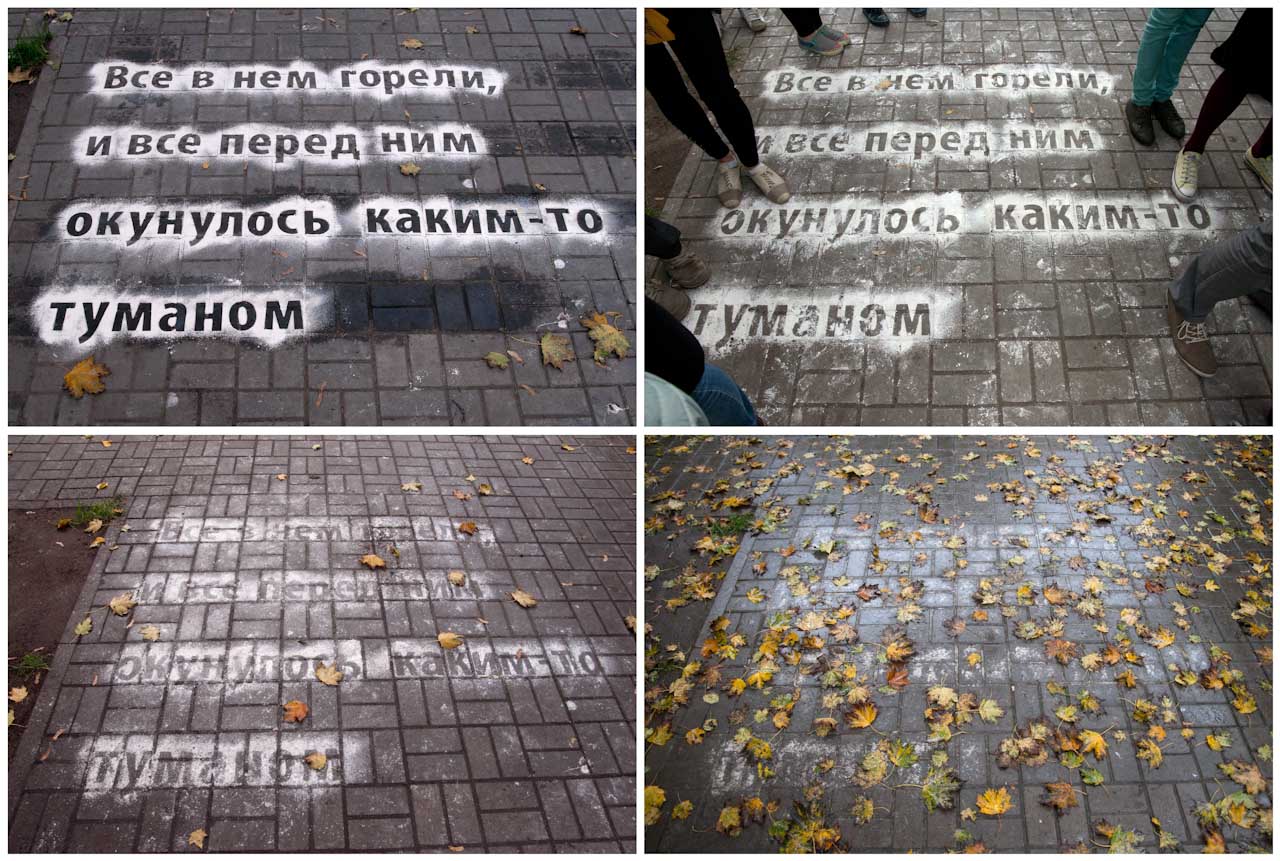
Nicholas Fraser’s project, titled “Nevsky Prospect,” made use of text from a short story by Gogol, a classic Russian writer who is equivalent to Mark Twain for Americans.

As Liteiny Prospect runs off of Nevsky, Nicholas decided to use this story in a temporary chalk installation, breaking it down into 40 or 50 short separate bits of text that he and his assistants laid down on the streets and pathways of the thoroughfare and courtyards.  One of the biggest challenges Nicholas faced when putting this piece together was the logistics; not being familiar with where to obtain materials and even interactions with material manufacturers provided a challenge to him before his work was to be installed:

“If you’re in a city that you’re not familiar with and you don’t speak the language you really become dependent upon the people who are assisting you and what they know.  There were a couple of days of just running around like crazy looking for the things that I needed, but we got it all just fine and it worked out.  Russia is a little different in terms of manufacturing services; I ordered these plastic letters for my piece and I had them cut in Russia, and I remember getting the order and I looked at the box and thought, ‘this looks great, but it doesn’t look like there is enough here.’  I did a count and I had exactly one of each character, and I had of course ordered multiples of them to make it easier and faster.  Over the course of the next four or five days with an installation looming, they trickled in from this vendor.”

The reactions to his “Nevsky Prospect” piece were hard to gage as Nicholas doesn’t speak any Russian and had to rely on his assistants to translate, but he was able to get a sense of what the observers thought based on looking at them:

“…it was everything from mystification, ‘what are you doing and what is this and why is it here and this is art?’ all those kind of questions, to people who knew the story and recalled the story and were very thankful of me doing this piece.  I had a lot of people thanking me wholeheartedly for this and for the larger project, because there were a lot of different works happening, a lot of different types of works, performances and things like that. “

Terry Hardy

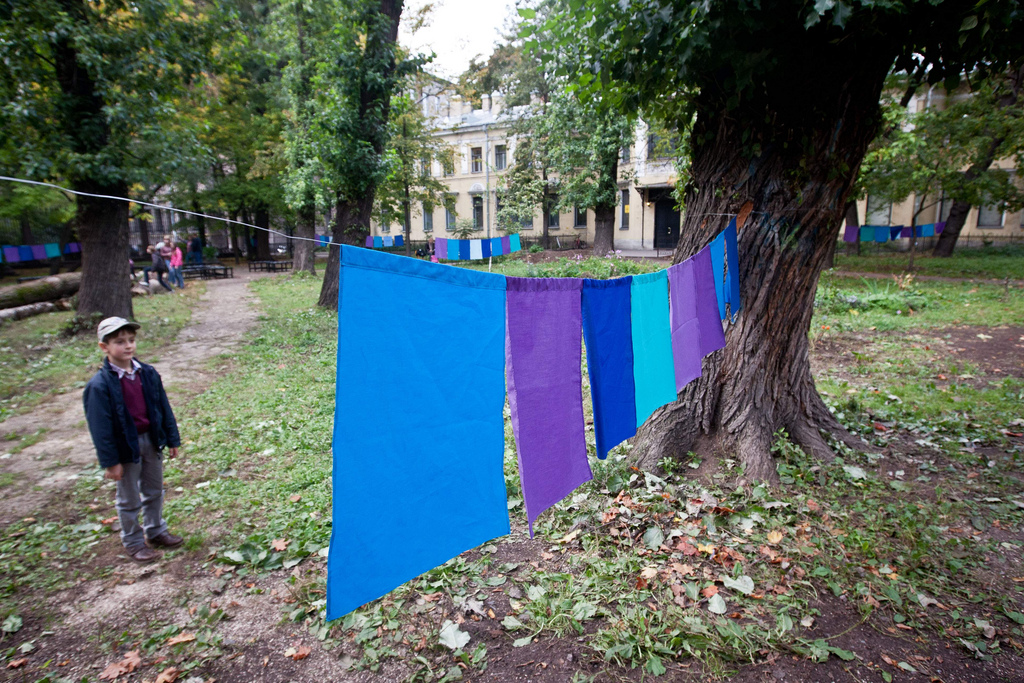
Blue, Terry Hardy. Photo by Evgeniy Luchinskiy.

Terry Hardy’s installation, titled “Blue,” took advantage of an old courtyard off of Liteiny Prospect.  The idea behind this installation was loss and it involved blue flags/banners that were set up fencing an area of the courtyard.  These flags were embroidered with about twenty words from an Alexander Pushkin poem that Terry had found the most striking.  Although not the first time he had produced a project of this kind, every time Terry does a fence/banner project he finds the whole experience to be very emotional, and his use of Pushkin’s words in this particular case had a very directed effect on the emotional involvement of the public observers:

“The words were very somber, it was not a happy, uplifting wonderful piece; one of the older residents came down and asked my why did I pick such sad colors for such a beautiful time of the year, and once my assistant explained that to her and the words were very sad, and once she understood the Pushkin connection she was fine with it, as well that it was only temporary and wasn’t going to be there forever.  Everybody else was very optimistic, some of the people have lived there their entire lives; it was very amazing.”

By the end of the installation, Terry had found that the piece had an even more profound effect on the community than he had originally thought, even getting pleas from the woman responsible for managing the area and several residents to leave it up for a longer period of time.

Sheryl Oring

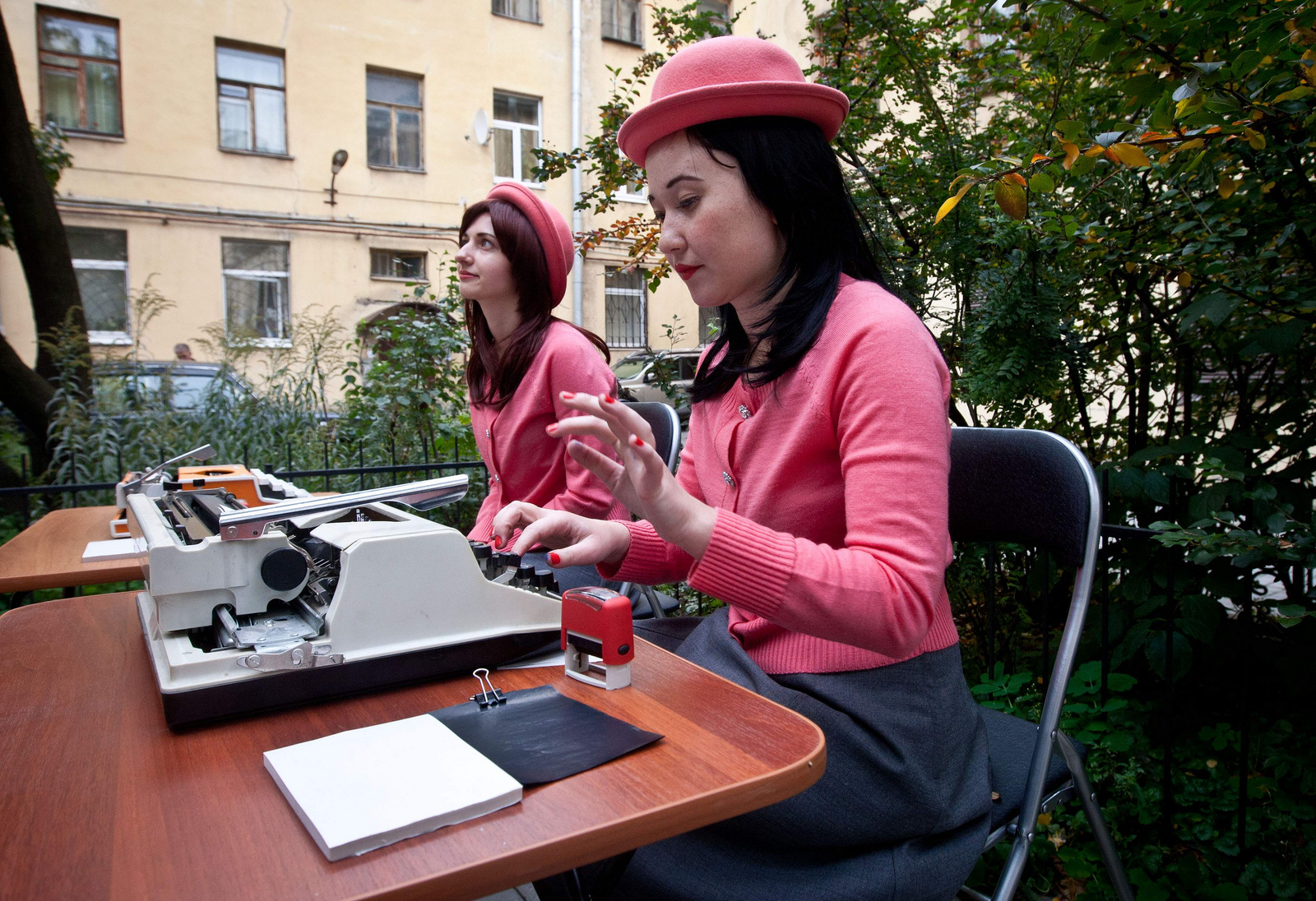
Role Model , Sheryl Oring. Photo by Evgeniy Luchinskiy.

“Role Model” was the title of Sheryl Oring’s piece, which involved two Russian typists sitting at little tables along Liteiny Prospect and within the courtyards as they asked and recorded people’s responses to the question, “what can Russia teach the world?”  Part public performance piece, part sociological survey, Sheryl “found a really willing audience and a very broad based audience” during the run of her work, encompassing participants from a variety of backgrounds, including “some art folks who knew about the festival, but also grandmas that lived in the apartment complex next door.”

The most difficult part of this piece for Sheryl were the logistics, as she was unfamiliar with St. Petersburg and only met the typists she would be working with when she arrived in the city:

“I had never met the typists before I went to Russia, I’d never seen pictures of them and I had to try and figure out what they would wear ahead of time and I had no idea what size outfit I would bring to them.  When I got there it turned out I brought a couple things and nothing really worked, so on the spot I needed to figure out where to look for the things, I don’t speak the language, how to get from here to there, all those really practical difficulties, but fun in a way as well.  One of the biggest challenges was not knowing the landscape and having to figure out quickly what the possibilities were and how to work.”

Photo courtesy of CEC ArtsLink.

Despite the logistical setbacks in the beginning, the project was executed successfully and the answers Sheryl received not only helped her get a sense of the socio-cultural atmosphere of Russia (at least from the perspective of the citizens of St. Petersburg), but also gained some unexpected insight into the resilience of the Russian people:

“The answer I will never forget from this question was ‘Russia can teach the world how to be sad;’ it was so deep and profound and in a way it was touching to see the dignity people lived with, through a lot of war and a lot of difficulty and violence in their own country and how people live today still with that history is quite amazing.”

The success of Sheryl’s project in Russia has influenced her to continue with this idea, examining the reactions to the same question in different cultural contexts:

“I just did the second performance of this in Brazil, in a very different context.  The work in Russia spawned a series of new performances that are taking place in different parts of the world.”

Future Prospects

Overall, the festival was well received and the responses to it helped solidify the success of the experience.  “Most of the public reactions were positive,” remarked Susan, “there were a few cranky residents who were not happy to have artists milling around their courtyards, but most people seemed to enjoy the objects and performances.”  Ed and several artists also participated in a panel titled “Art in Urban Spaces: New forms of cooperation with society,” held at the independent art space, Etazhi.  The panel focused on presenting art in the public sphere; during the panel, Ed discussed AiOP, its mission and its festival, while the other participating artists talked about their works and how they relate to the topic.

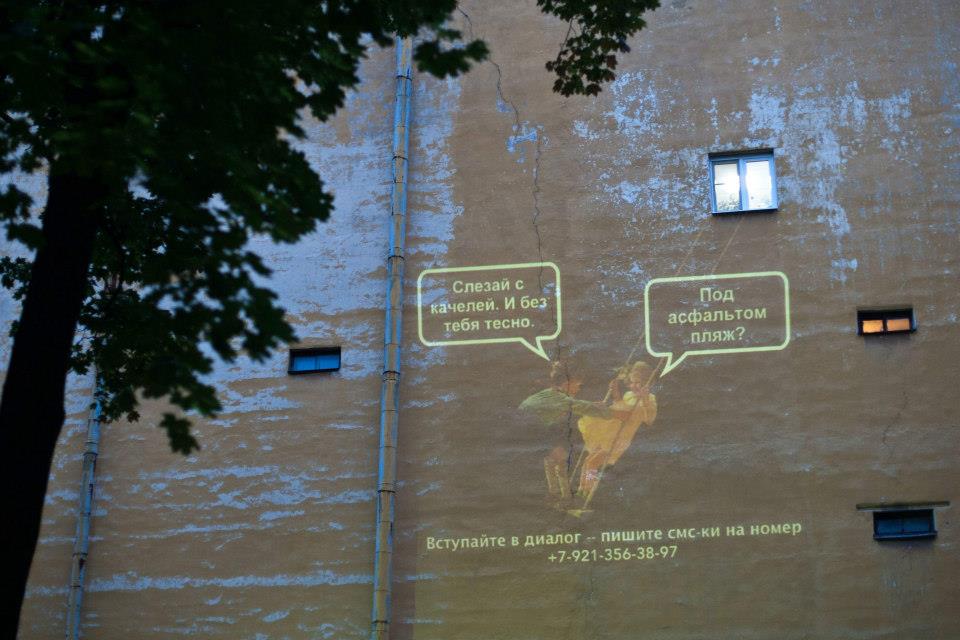
Paul Notzold’s “TXTual Healing” allows viewers to text phrases to be inserted into the dialogue boxes projected on the building wall. Photo courtesy of CEC ArtsLink.

As for the future of the Art Prospect festival in Russia, everyone generally agrees that the success of this festival has helped to set a positive precedent that will help break down barriers and reduce restrictions that might arise when organizing the next one.  “In the future I know it will be so much easier for them,” Terry remarked,  “and of all the Russian artists that were involved, we realized they were pretty important locally.  Now that it’s all said and done and we’ve done our research, we realize there were some pretty amazing people there that put a really wonderful show together.”

More images of the festival can be found on the CEC ArtsLink Facebook page and the AiOP Flickr.