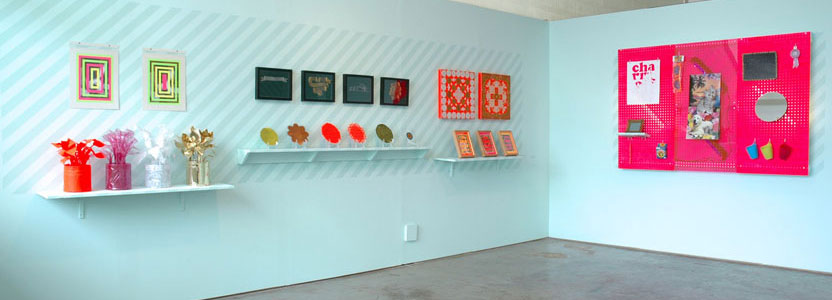
By Matthew Morowitz
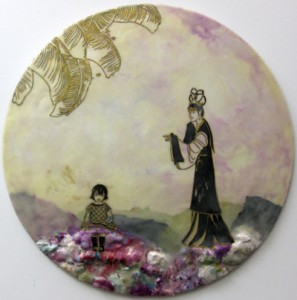
“What A Treat” 2010, encaustic and mixed media on panel.
Cecile Chong is a mixed media artist whose work focuses on the processes of acculturation and the construction of individual identity. Chong, who was born in Ecuador of Chinese parents and currently lives in Brooklyn, has exhibited her work throughout North and South America, as well as the United Kingdom. Looking at examples of her work, it becomes apparent how her cross-cultural curiosity is reflected in it; examples from her painting series, such as What A Treat and Feeling Blocked bring to mind Chinese pottery through the arrangement of the space and figures. However, the figures themselves are drawn from different cultures and time periods, while the color scheme and textures of these works bring to mind 20th century Western painting more than Eastern porcelain. Painting is just one of the mediums that Chong works in, as her website also has examples of her sculpture, installation, and a series that involved kitchen strainers.
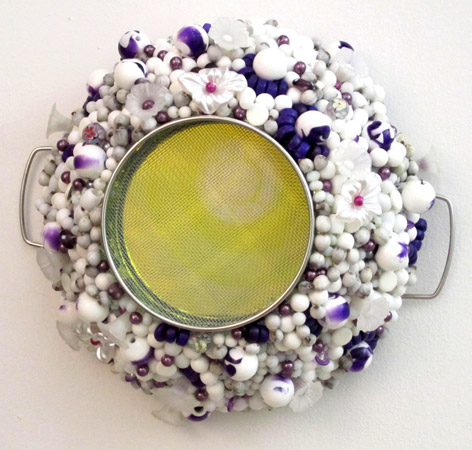
“Lace Strainger” from Strainger Series, 2010, mixed media.
Her new project PLEASED TO MEET ME, an interactive installation that draws from the myth of Narcissus and uses three different colored panels of reflective glass in order for the viewers to observe and appraise themselves, essentially highlights and encourages the egoism and vanity that has become prevalent in “our times of social media where we become our own critics, paparazzi and publicists.” Below are the answers to some questions I asked Ms. Chong regarding her work, her motivations, and this project, which will be appearing in the Art in Odd Places 2012 festival: MODEL.
What inspired you to create PLEASED TO MEET ME?
My work deals with the process of acculturation and cross-cultural encounter. PLEASED TO MEET ME is an extension of my work. Here, I was thinking about how we see each other and make simple, quick judgments. This piece invites viewers to encounter their image tinted in three different colors and think about how they and others react to their own reflection and contemplate how that reaction is driven by the viewer, the viewed, and the lens through which they are looking.
Would you say there is power in myth and do you think it is important that myths are translated to fit the needs of a contemporary audience?
I think all the stories that are written and all the art that is made is a constant reinvention (both active and passive) of what has come before. To be powerful those reinventions must not only resonate in a contemporary context, they must inspire spiritual or societal change.
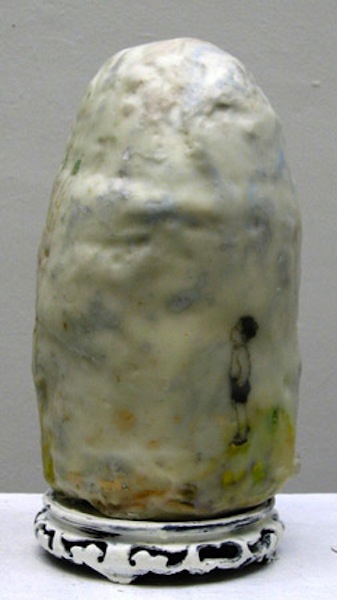
“Calling” 2008, encaustic, plastic, plaster and mixed media.
Does this project relate to any of your previous works? How does it differ?
I have done an installation titled SOLARIUM at Corridor Gallery, where I similarly used three different-colored tinted wall panels. In that case, I used the reflective panels to create an enclosed space in which I inserted small white sculptures representing tabula rasa (blank slates) or the human being, void of cultural influence. The viewer was asked to share the space with them, and see the sculptures (and themselves) painted by the enclosure. SOLARIUM was intended to be much more of a private and contemplative experience about how we see ourselves and who we really are under the layers of acculturation. I see PLEASED TO MEET ME as much more public and extroverted. It’s about how we want to be seen, how the world sees us, and how the two things may or may not reconcile.
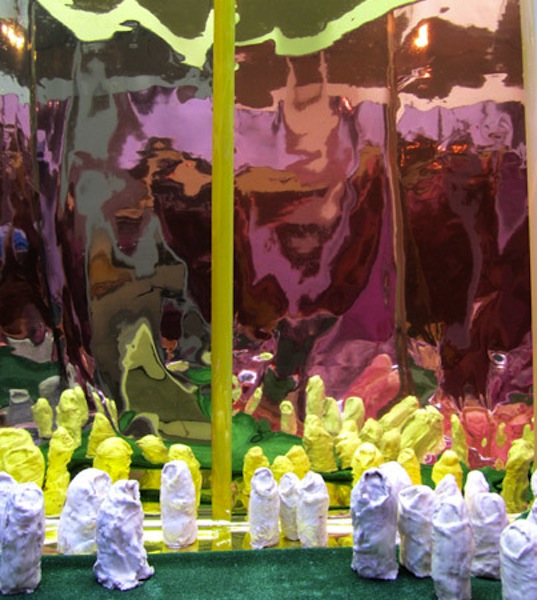
“Solarium DETAIL” 2010, mixed media, Corridor Gallery.
What do you hope people might learn about themselves through PLEASED TO MEET ME? What kinds of reactions do you hope to observe?
First, I want people to have fun with it looking at their own reflection. I hope they stay long enough to question notions of MODELING as the concept of this year’s theme. I want them to stay long enough to start feeling self-conscious about admiring themselves in the mirror. I also want viewers to perhaps question “why three different colors?” The underlying idea is that culture functions as a filter and the way we see and are seen has to do with our own and others’ experience. It is a “to see and be seen” sort of experience.
Do you think you will explore the ideas behind this project in future work?
Yes. I think I will be looking for ways to broaden, deepen and make more accessible my work in this area of inquiry, especially in a public art context.