By Matthew Morowitz
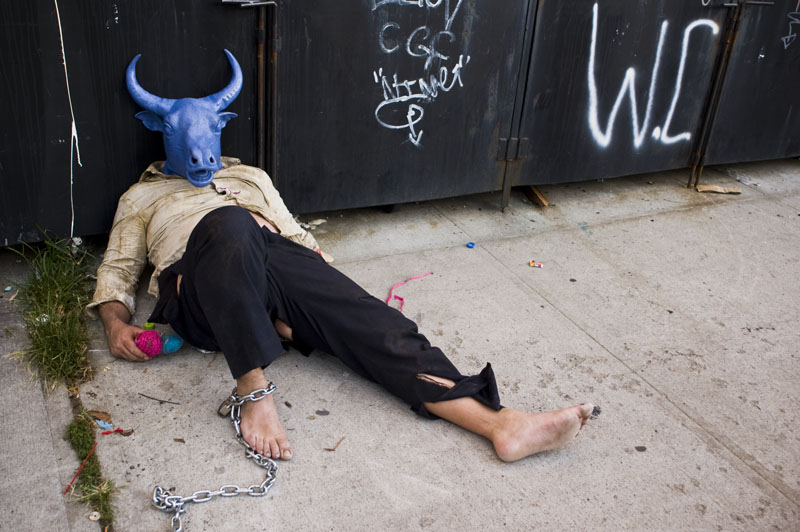
Photo courtesy of Ryan McManus
Rob Andrews is an artist, performer, writer, teacher, father, but above all, a storyteller with a large variety of audio, visual, and performance works that tackle ideas surrounding myth, ritual, and memory. A graduate of Bates College (a “funny little place” as he describes it), Andrews apprenticed with William Pope L., who was his mentor for three years, as well as an “artist, theater practitioner, and all around super genius.”
Andrews moved to New York City after college, where he is currently teaching literature. He got his start at the Exit Art gallery, a 30-year-old institution that has recently closed, with his project “Clean Exit Art,” a performance piece that involved cleaning the gallery for months with a tooth brush. This project became the first of many different “Clean” work that he would go on to perform.
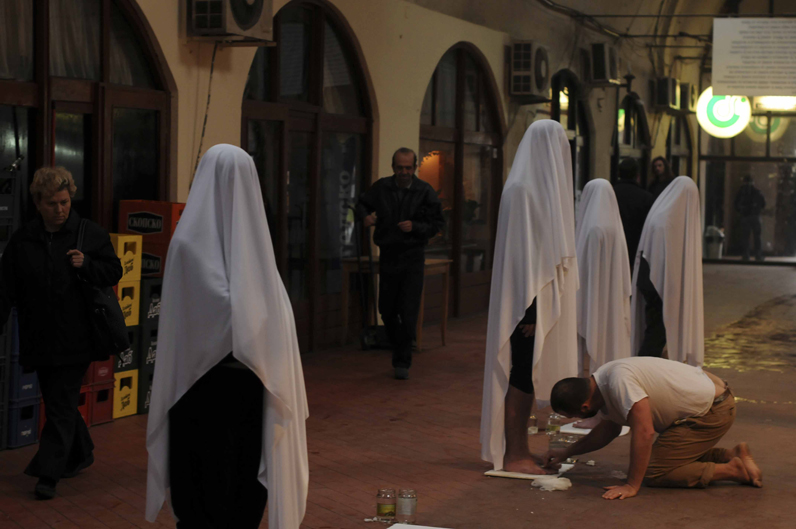
“Clean Bitola” photo courtesy of Ryan McManus
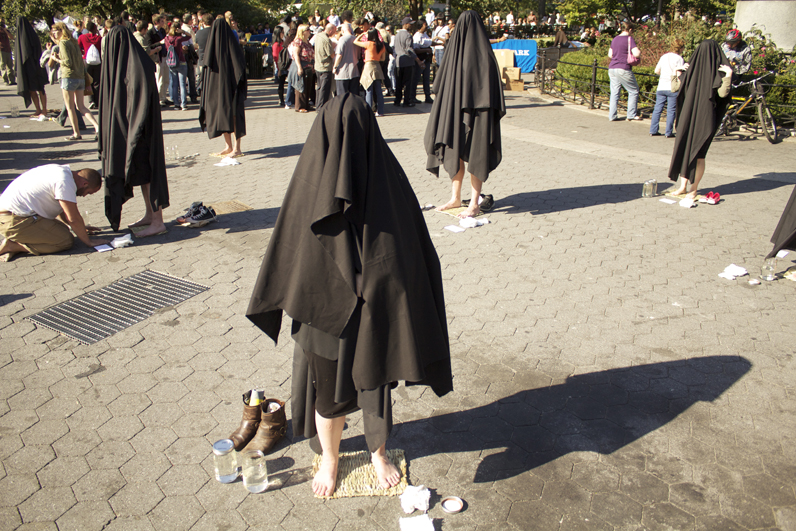
“Clean Union Square” photo courtesy of Ryan McManus
His performance work is mainly concentrated in the NYC area and out of the gallery English Kills (part of the “Bushwick scene” and “very unconventional” as described by the artist), but he has undertaken projects in places as far away as Bitola, Macedonia. Recently, I was able to talk with the man behind the Minotaur mask over the phone about his work.
What first inspired you to create works around the ideas of ritual and story?
I’m a writer at heart. A storyteller. I teach literature, and forgiving and forgetting the splintering of our digital selves into an impossible number of pieces … it’s still our ability to write history and reflect on it. That is the most hopeful and interesting part of us — the metacognition of our place in histories — the veil! Ritual and religion are just warmer histories. Ritual is the way that we negotiate history and transmit it, change it, fuck it up. Our brains require repetition to understand and change new skeins to skins. I was a choir boy. I was a chicken cook. I was an actor. I’m a son and father. I’m the minotaur, and I’m no one.
Story’s all we’ve got.
What myths and beliefs have been the most appealing to you and had the most impact on your work?
Joseph Beuys believed that art was the most powerful social and sculptural force in the world. In history. Social sculpture, he called it. This is a way of seeing as much as doing as I interpret it — and if it’s not a myth, let’s call it one right now. The Beuys Myth!
Believe me — this isn’t sleight of hand here — but beliefs aren’t appealing by definition. Every time (and I run the risk of the tortured artist trope here, which I seriously want to avoid) I understand the heart of a work — the thing that I have to do — I feel nauseous. It’s like watching a storm start to break over the water. Sometimes it will hurt less than others, or I won’t have to be as afraid as last time. But a “performance” for me isn’t about choice. It is fundamentally about belief.
As in: I believe that this thing I have seen in my mind or in a dream is serious, complete, and of a certain magnitude. So much so that I have no choice but to go ahead with it.
I believe in fear. I believe in void. These are the things I have evidence for.
I mean, if you had a gun to my head, that’s what I’d say.
Does the idea of “shock value” factor into your thought process when coming up with new works?
Again, at the risk of annoying you, isn’t “shock value” as subjective as sublimity or beauty or transcendence in any given time or context or space? The incredible responsibility of artists that make “performance” is that time, space, narrative, movement, commerce … all of these factors impact the construction of a work, and a work must be immediately responsive to these factors or die and become polemic. I don’t mean to say that a static sculptor or painter doesn’t have to deal with these concerns, but the so-called “performance artist” is held more immediately accountable.
In my experience, my work is the opposite of shocking. I have been kicked, screamed at, had long fluorescent bulbs broken over my body, had beer poured on me. The whole gamut of person-to-person violence. And this isn’t because I’ve got my pants down or am particularly provocative. I’m often in a position of powerlessness, or at least, meditative repose. There’s something about my work that brings out the worst in people.
Here’s my theory: that if the “audience” doesn’t get what they want, they activate and become the “performer.” That sounds very neat and all, and an action in a place is an action in a place, but if we have to parse, I think that we live in a culture that aspires to theatrically immediate satisfaction (that is, if you’re not poor). And if satisfaction isn’t immediate, it invites intervention.
I present an imposition in my work. A disruption, and deny (on some level) a convenient or straightforward explication.
How does the idea of space factor into the types of work you do?
Absolutely. But what a tricky word! I have friends that understand the body as infinitely large and porous on a spiritual scale. Others that understand the body as infinitely large and porous on a scientific scale. I worked as a janitor in a Catholic church where my boss also ran the cemetery. His understanding of space was incredible. He moonlighted with the funeral home after a time, and assisted in carrying the recently dead from their beds. From their lover’s arms. From their bedrooms. Down hall. Out through doors. Into cars. He said the mortician’s jokes changed the space around a body!
I try so damn hard to read space and inhabit it. Wiser more powerful people than me get it in much more profound ways.
Space is the page. Space is the altar. Space is seeing. Space is being seen.
How, if at all, does the idea of redemption play into your works?
This is where I might clamp shut. Our biggest flaw isn’t it? The idea that we can balance the scales at all, not least with storytelling? Are my works redemptive to me? To be honest, I erase them from my memory as soon as I’m done with them. It takes me years sometimes to build up the nerve to look at the images of a performance.
Redemption as an idea and word has so much weight. Every action has an equal and opposite reaction. To call the reaction redemptive might be reductive.
What, if anything, personally drew you to the myth of the Minotaur and the use of the figure as a subject/in your work?
The Minotaur is a re-contextualization of the mythical archetype. He is a totem of American male impotence … the child of empire: strong, dumb, chained up, and forgotten. The Minotaur is a symbol of our spiritual dreck, forgotten by his creators as the empire collapses in on itself. The Minotaur is my dad. My son. My wife. I love him. I pity him. I fear him. He’ll be left after we’re gone, which is an idea I’m exploring in a massive interactive project I’m working on, End of Empire, an online “game.”
Here’s my one-line pitch:
Humanity perishes, and 75 years later, the Minotaur wakes up, wanders the land, encounters wraiths, uncovers stories, and comes to terms with who and what he is.
The game has no defined end and will likely be very non-linear and open-ended. I’m working with musicologists, graffiti writers, and other artists to build this world. This is about visual, psychic and spiritual exploration, and I want it to really fuck the user up. I just spoke about it at an incredible game design summit, and received incredible feedback.
The powerful thing about myth is that it can be translated, polluted, interpreted, or thrown out.
Matthew, you are the Minotaur.
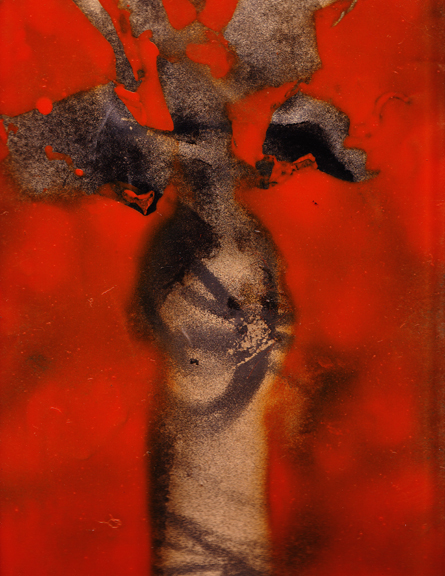
“Wrathful Deity”
In the game, the player can not only control the Minotaur’s interaction with his environment, but also with places from the player’s own memories through the use of geo-tagged images from the public domain. Andrews hopes to show that “all of these representations of ourselves and all these pieces of our lives are just floating around in the world and like some stories and some memories are so powerful that they might live beyond the apocalypse.”
For this project, Andrews also enlisted the help of biologists to plausibly put out the scenario of which animal, which creature, has become the dominant species once the humans are gone. Working with so many specialists, Andrews feels his role in this project is more like a director but is excited as he is getting the opportunity to invent a new world and a possible future, which he describes as “really heady and beautiful stuff, but also a lot of hard work.”
Matthew Barney and his “Cremaster Cycle” films inspired Andrews to want to create “something like that, something that ambitious.” But unlike Barney, Andrews sees film as a “really antagonistic medium,” as the filmmaker is “presenting someone with their ideas, leaving [the audience] in the seat,” whereas the idea of a game allows people to “negotiate [this] world as an avatar and what can be more preformative than that, making the audience the performer.”
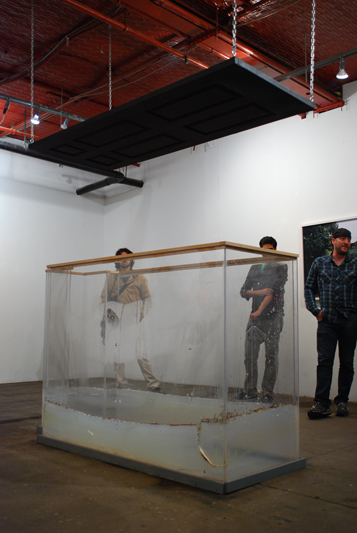
“Thrall Door” photo courtesy of Ryan McManus
A discussion of Andrew’s piece, “Thrall Door,” which was a dark metaphor for life that used ants, lead to a discussion of how the audience engages with his work, as he found that their biggest reaction to this piece was quite curious and childlike, not what he was expecting for a work that carried such a heavy message.
“Once an audience engages performance particularly, but also an object or a drawing or something hanging on a wall, like I think they actually become the storyteller,” Andrews mentioned, preferring to let the people become the performers by their interactions with him in his performance space, and seeing people “take that narrative and plant it in their own soil.” In his own work, he is most interested in “creating a little vortex people have to enter and say ‘I don’t know what’s going on here,’” feeling totally successful if the work accesses people at a subconscious level.
Photo courtesy of Ryan McManus
Talking with Rob Andrews felt more like equal parts history class and philosophy oration, which not only gave me a better sense of his works than having viewed and read the descriptions of them from his website, but also made me understand why his work is so powerful. Unlike other artists who can make a work that has a message, Andrews’ works are intended to pull us in and make us a part of the message, one that he is not trying to get across but instead having us, the audience, help him create. As for the kinds of meanings he hopes his audience would find through his works, he is less interested in the “comforting and convenient” and more in the “abrasive, the things that grate us, and the things that challenge us and the things that we will probably end up loving anyway.” I understand now what Andrews meant when he said I was the Minotaur, and I think that as long as he will have an audience that is willing to engage with his work, we will always make and remake the Minotaur, as we will always make and remake Rob Andrews, because ultimately we will be the ones who are translating, polluting, interpreting, or throwing out the myths and narratives that guide our lives, our histories, and our experiences with Andrews’ work.