By Ruthie Snoke
Art has the ability to challenge popular opinion, to reshape the lens through which reality is viewed, and to provide closure when it is needed. Sometimes, it seeks to encapsulate these three things at the same time. The performance piece “155 Years, 155 Blocks,” created by multimedia and performance artist Jesse Kreuzer, an alumnus of The Cooper Union for the Advancement of Science and Art, attempted to do just that.
The impetus for Kreuzer’s piece—who is now in graduate school at Cornell University—came when Cooper Union, a long-standing institute of free education in a world where college debt is steadily increasing, announced that it would be charging tuition this Fall. In the opinions of most of the faculty, current students and alumni of the college, this is a devastating loss. Kreuzer’s response was to stage a performance piece that allowed the students and alumni a chance to express their feelings.
“I don’t have a hard time pointing fingers, but I have a hard time pointing fingers with my art,” Kreuzer says. Performed in November 2013, what began for him as a protest piece took on an unmistakable air of grief. “It was necessary to have that moment of mourning.”
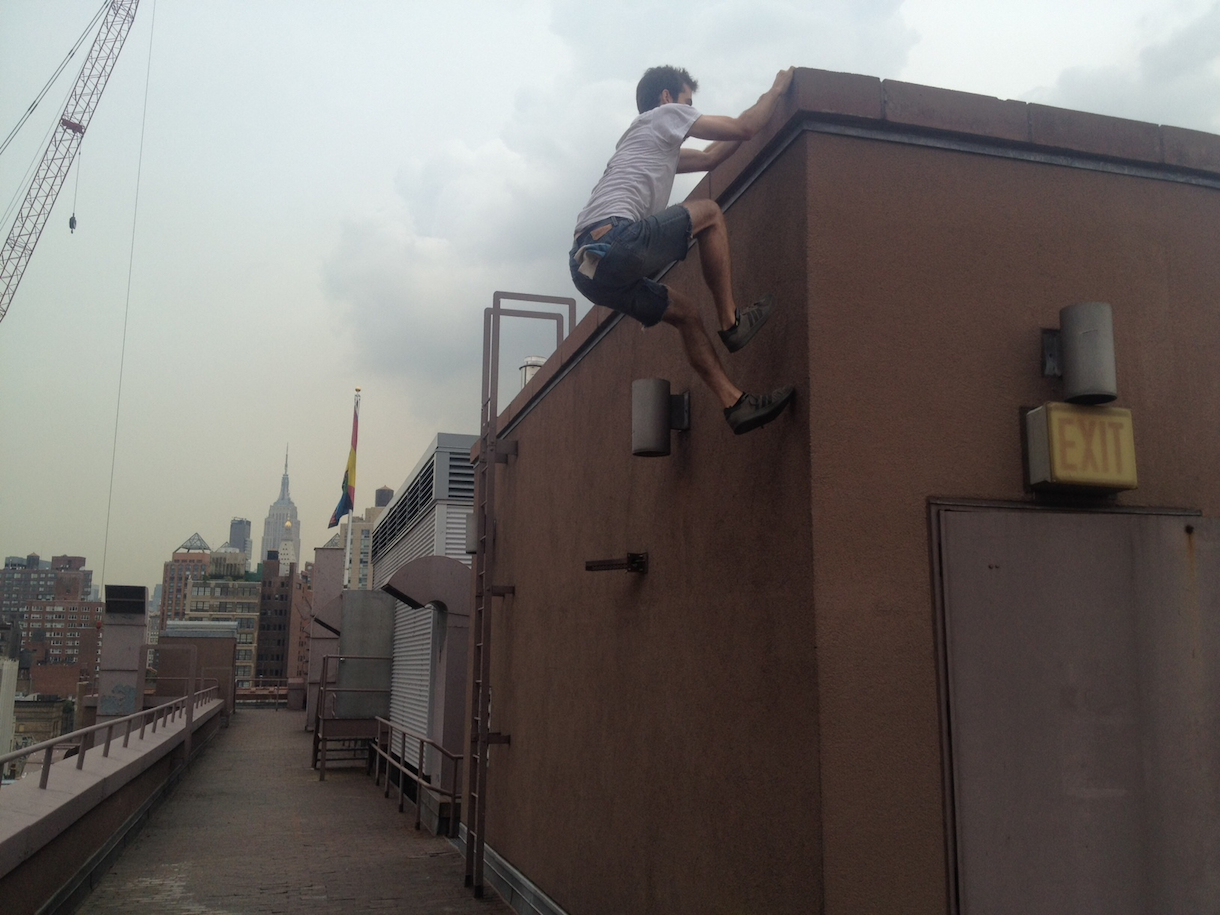
Jesse Kreuzer climbing Cooper Union. Photo Courtesy of the artist.
Cooper Union was begun by industrialist Peter Cooper in 1859 as a way for the underprivileged to have a means of free education. Over the past 155 years it has become a school that, because of its admission-by-merit-only policy, is highly selective, competitive, and, according to Kreuzer, cultivates a unique environment.
“It’s refreshing to be in a place where money is not part of the conversation,” Kreuzer says. “The goal is to do your best work possible.” A goal that, if Kreuzer’s dire predictions prove correct, may soon change with the advent of tuition costs limiting the number and type of students applying for admission.
As is to be imagined of a competitive school that does not charge tuition, Cooper Union has always struggled to make ends meet. However, between an endowment, various rental payments, a unique property tax arrangement, donations from alumni and students, and occasionally the generosity of board members, Cooper Union has remained tuition free for over a century and a half. The administration, students, faculty and alumni have been united around Peter Cooper’s original vision and have agreed that, “Education should be as free as air and water.”
Over the past few years, however, Cooper Union has seen a once united campus turn into a battleground between an administration, led by President Jamshed Bharucha, that wants to charge tuition, and students, faculty and alumni who are bitterly opposed to the idea. It has come to the point where many, including Kreuzer, believe their opinions and suggestions are falling on deaf ears, and some have even suggested that President Bharucha was brought in specifically to lead the tuition charge.
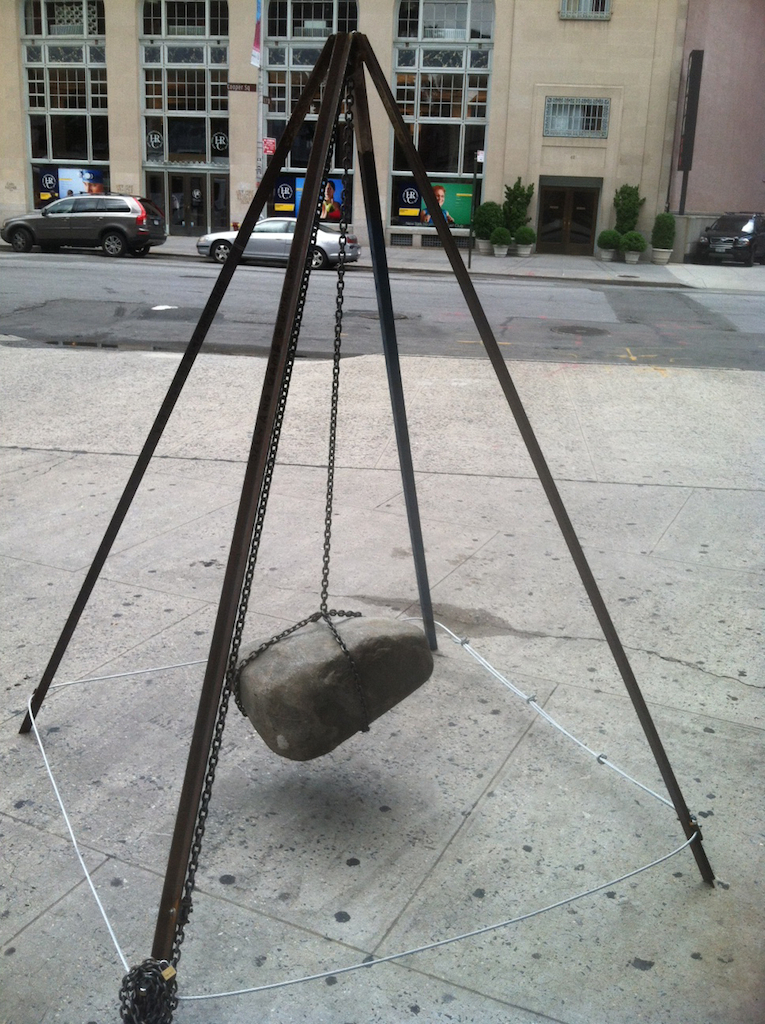
The stone suspended in it’s sculptural setting. Photo courtesy of the artist.
The students and alumni have responded in a variety of ways, including forming committees and groups to look into alternative methods of providing funding for the school. Friends of Cooper Union, one such group, created a pamphlet titled “The Way Forward,” which laid out options forthe school that would remove the need to charge tuition. But as each suggestion was rejected, students and alumni became more frustrated, until a group calling themselves Free Cooper stormed the president’s office and held it hostage for months. The standoff lasted until it was successfully mediated by a Cooper Union staff member, who was later let go.
According to Kreuzer, the tensions have been exacerbated by the administration, whose methods have, in his opinion, been “draconian.” When it came to his performance piece, however, Kreuzer found himself beyond anger, and entering the realm of grief.
“I understand enough of [the politics] to know where I stand,” Kreuzer says, “but this action was less about politics, and less about pointing fingers than really about mourning the death of a place and an identity and an institution that we really love. It was a cathartic moment for us, this day-long mourning, and if we hadn’t done it I would feel worse than I do.”
“155 Years, 155 Blocks,” centered around a rock Kreuzer used several years earlier, during his final show at Cooper Union. In the original piece, Kreuzer scaled different parts of the architecture in the building he had spent four formative years working in, traveling all the way from his studio on the sixth floor down through the building and outside, all without touching the ground. Once outside he asked his audience members to help him lift the 300 lb stone, found during fortuitous construction on West 4th Street, and suspend it from a wooden structure, which Kreuzer had built.
Kreuzer described the piece as his “love letter” to Cooper Union, and spoke about how it was a “dance with the building—a way of understanding” the place. The fact that he never touched the ground while climbing through the building, along with the suspended rock, symbolized to him the freedom his education had given him to pursue his art without the crippling debt many students are faced with after graduation.
The symbolism of Kreuzer’s later piece, using the same stone, is clear. In a show of solidarity with the school, Kreuzer reattached the rock to a metal structure in front of the building, but five months later the administration informed him that the stone would need to be removed. The sculpture had gained such symbolic and emotional weight, Kreuzer felt bereaved being forced to dismantle it, and decided to use the demolition of the structure as a chance to protest and, more importantly, to mourn.
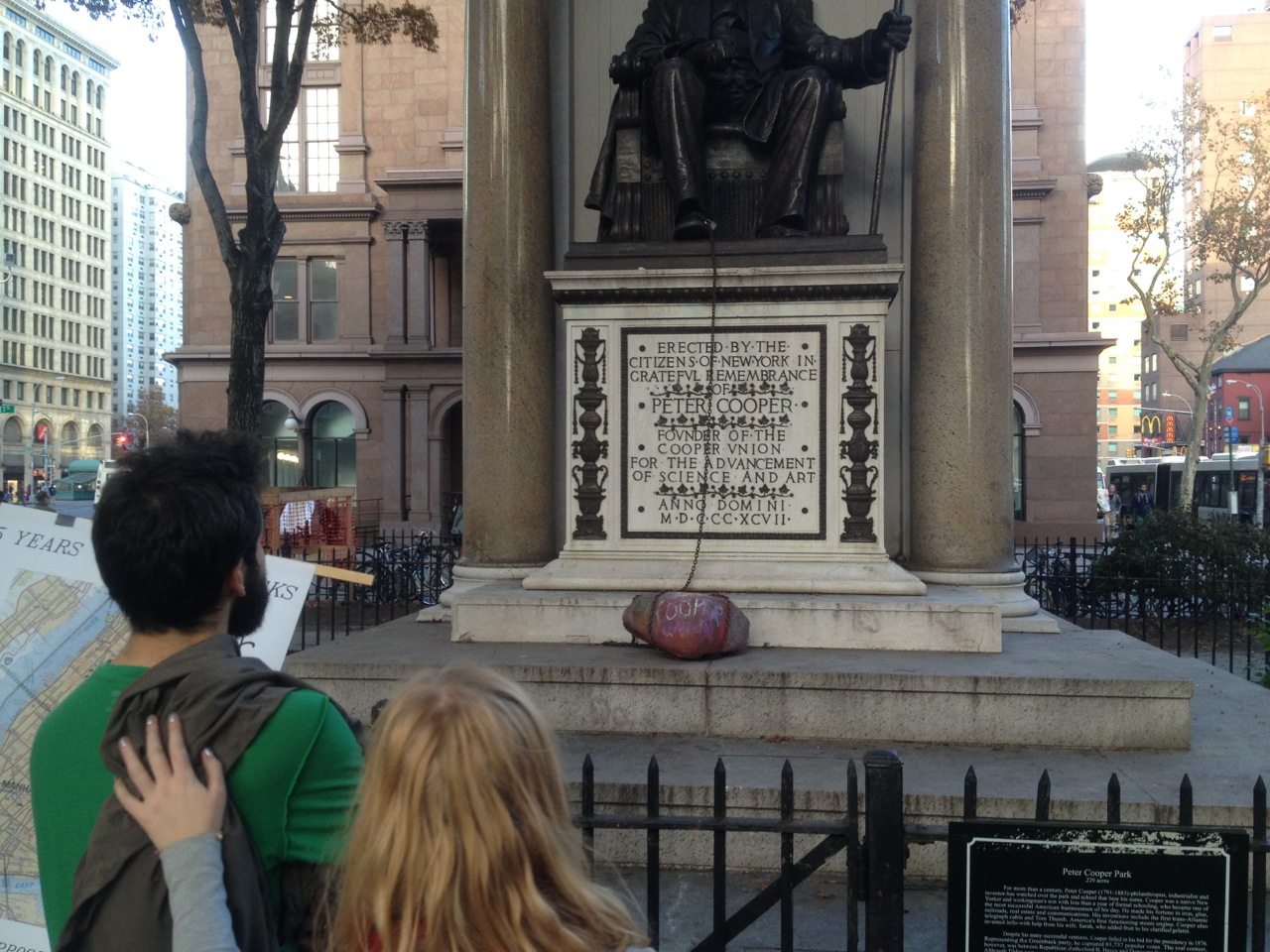
The stone chained to the statue of Peter Cooper. Photo courtesy of the artist.
Kreuzer and the other participants began early in the morning by lowering the stone to the ground while they read Peter Cooper’s obituary. They attached straps to the stone and dragged it 155 blocks through the city, pausing in front of various buildings which have historically offered free education to the public, such as the New York Public Library and the Metropolitan Museum of Art. In some locations the participants read famous speeches from individuals who have been influential in the history of Cooper Union, such as Abraham Lincoln, who gave a speech in the Great Hall, W.E.B. Du Bois, Susan B. Anthony and others. When they arrived back at Cooper Union late in the day, they circled the building several times before chaining the rock to the statue of Peter Cooper.
The rock and chain were removed later that night, and Kreuzer has not seen them since. He initially thought the march might ruffle some feathers and make waves, but if the administration heard about it, they did nothing to indicate it. In retrospect, Kreuzer believes there is a certain poetry to the piece and its reception.
“My relationship to this school has been severed,” he says. His sentiments are not unique, and with the continuing protests and resignations of staff members, the environment of Cooper Union is anything but peaceful. There is even a lawsuit being brought against the school that maintains the board has broken the founding values and mission of the school, and it is rumored that it may even go so far as to suggest that criminal financial actions have occurred.
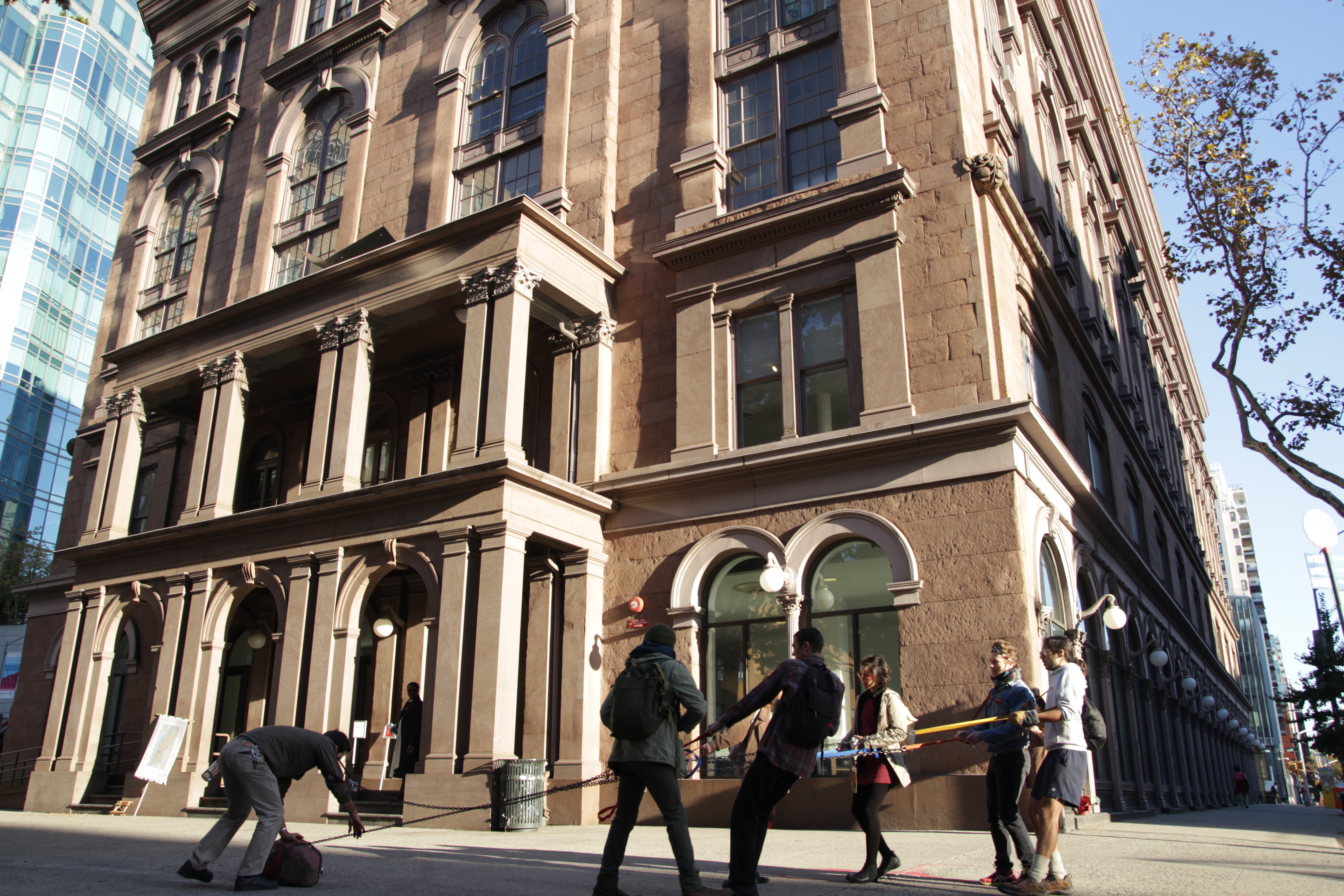
Dragging the stone. Photo courtesy of Mauricio Cortes Ortega.
Above all, Kreuzer and fellow alumni mourn the inevitable changes that will occur. What will happen when students who are now being charged tuition arrive on campus and realize that there is no gym, no cafeterias, no student lounges? Kreuzer and others like him are skeptical—to say the least—that the promise of low tuition will stand. “There is nothing keeping the school from outpacing both inflation and the average rate of tuition increase,” Kreuzer says. “In these kinds of realms people don’t keep promises they don’t have to keep. Especially if they’re hard to keep.”
When asked what he would say to the board if he got the chance, Kreuzer shakes his head. “[The board is] doing what they think is right,” he says, “but they should really take a lot of time to consider what it is that makes Cooper Union a unique institution. The board shouldn’t think first about how to make a school run no matter the cost, but first how to safeguard the identity, integrity and uniqueness of Cooper Union. To uphold its excellence first and foremost, and for that to be the principle they operate under.”
To current students, Kreuzer’s advice is simple: “Don’t forget the identity of the school.” The days of floating through the halls of Cooper Union without being weighed down by debt are gone, and Kreuzer and others will continue to mourn a place that provided them with a unique, thorough education and a free pass on the debt culture of today.